Two weeks after rollout, your new contract tool is already a problem.
Deals are taking longer to send. Reps are asking questions you can’t answer. Someone from finance is flagging missing fields. You’ve opened three support tickets and still don’t know how to fix the template.
So you do what everyone does: you send the contract as a PDF attachment and move on.
It’s not you. It’s the software.
PandaDoc’s own buyer research found that SMB leaders rate their agreement tools 5.4 out of 10 on satisfaction, while rating the importance of those workflows 9.1 out of 10.
That gap is the result of an entire category built for someone else. The contract management software market was designed for enterprise teams, and small businesses have been trying to force it to fit ever since.
The software was never yours to begin with
Most contract management tools weren’t built for teams like yours. They were built for legal teams managing risk across thousands of agreements. For procurement departments enforcing compliance. For IT administrators configuring permissions, workflows, and integrations across entire organizations.
At a 50-person company, those roles don’t exist. You don’t have a legal ops function. You don’t have a dedicated contract manager. You definitely don’t have time to map out a six-step approval chain just to send an NDA.
But that’s exactly what enterprise software expects.
The features that justify enterprise pricing (layered permissions, compliance audit frameworks, multi-stage approvals) are unnecessary for small businesses. They actively get in the way.
And the cost isn’t just what you pay on the invoice. It’s the weeks (or months) spent getting the system live. It’s the internal time spent figuring it out. It’s the deals that stall while your team tries to use it.
As one IT director at a regional bank described it: for smaller businesses, these tools are “either cost-prohibitive or just not available.”
Still, most SMBs follow the same logic: use what the bigger companies use. It sounds safe. Proven. Scalable.
It’s also why so many implementations quietly fail.
Contract management software might be the clearest example of this pattern.
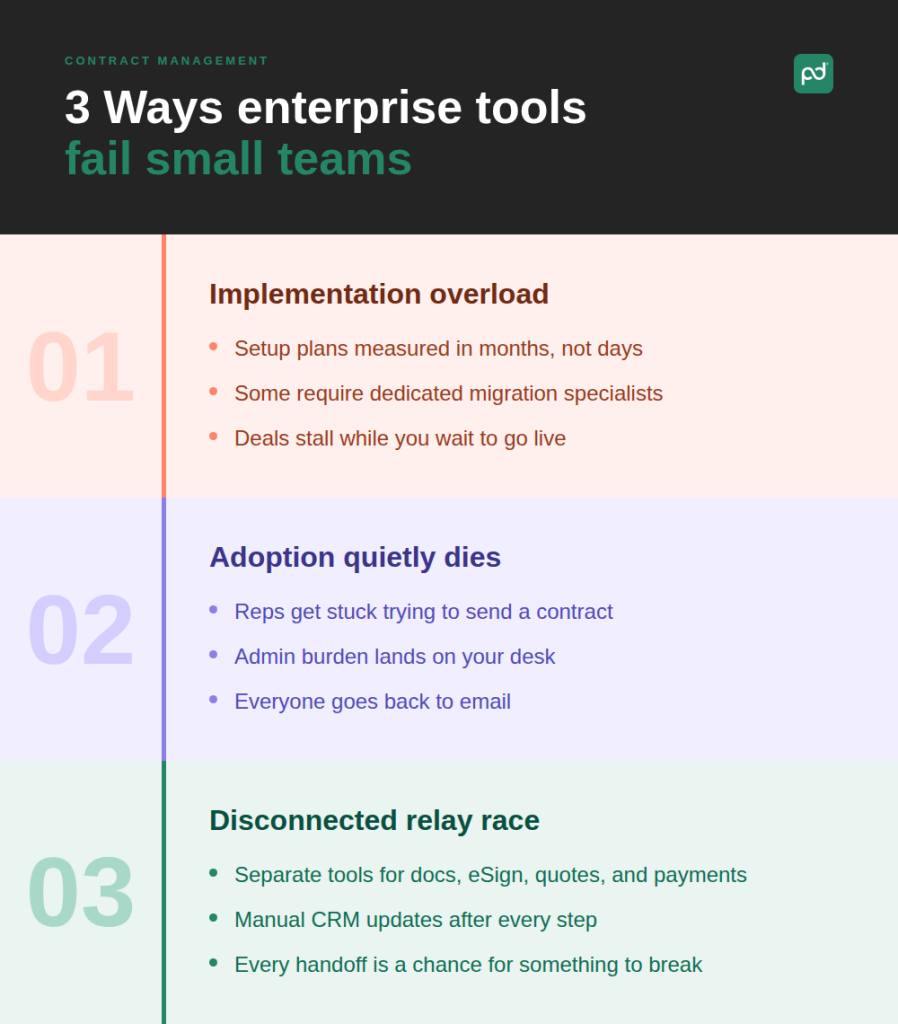
3 Ways enterprise tools fail small teams
These problems aren’t random. They’re the same three almost every time.
1. Implementation that takes longer than your sales cycle
Enterprise tools are sold with implementation plans measured in months. That works if you’re a global company rolling out a system across departments, but it certainly doesn’t work if you’re trying to close deals this quarter. Some of these tools even require dedicated migration specialists, which some teams can’t afford.
The very software meant to speed up agreements ends up delaying them. You spend months getting ready before the tool can do a single useful thing.
2. A learning curve your team will never clear
When you buy enterprise software, you inherit the burden of running it.
That means training sessions. Internal documentation. Support tickets. Admin work. And when something breaks or just doesn’t make sense, it lands on your desk.
This is where adoption quietly dies. Reps get stuck trying to send a contract. They message you. You try to troubleshoot. Deals slow down. Frustration builds. Eventually, people stop trying.
See how PandaDoc gets teams up and running without the IT tickets, start free
3. Disconnected workflows that steal time from every department
Even when enterprise tools work, they rarely work end-to-end.
One tool for eSignatures, another for document creation, another for quotes, and another for payments. What should be a single workflow becomes a relay race across systems.
Sales creates the document, ops fixes the formatting, finance tracks payments, and someone then manually updates the CRM. Every step introduces friction. Every handoff introduces risk.
The industry knows, and hasn’t fixed it
None of this is new. Vendors know small businesses struggle with enterprise tools. They’ve known for years.
So why hasn’t it changed? Because the market wasn’t built for you.
Enterprise customers drive the biggest deals, they justify the highest prices, and they demand the most features. That’s where vendors invest.
Which leaves SMBs with two options: overpay for software designed for someone else, or stitch together cheaper tools that don’t actually solve the problem. Neither is great, but both are common.
SMB leaders don’t think agreement management workflows are unimportant. In fact, they rate them 9.1 out of 10 in importance. They just don’t believe the current tools were built for them.
That’s a product-market fit failure–and the market has been slow to fix it. But that’s starting to change.
What contract management software for small business should actually look like
If the problem is structural, the solution has to be too.
Contract management software for small businesses shouldn’t be a stripped-down version of an enterprise product. It should be built differently from the start.
Here’s what that actually looks like:
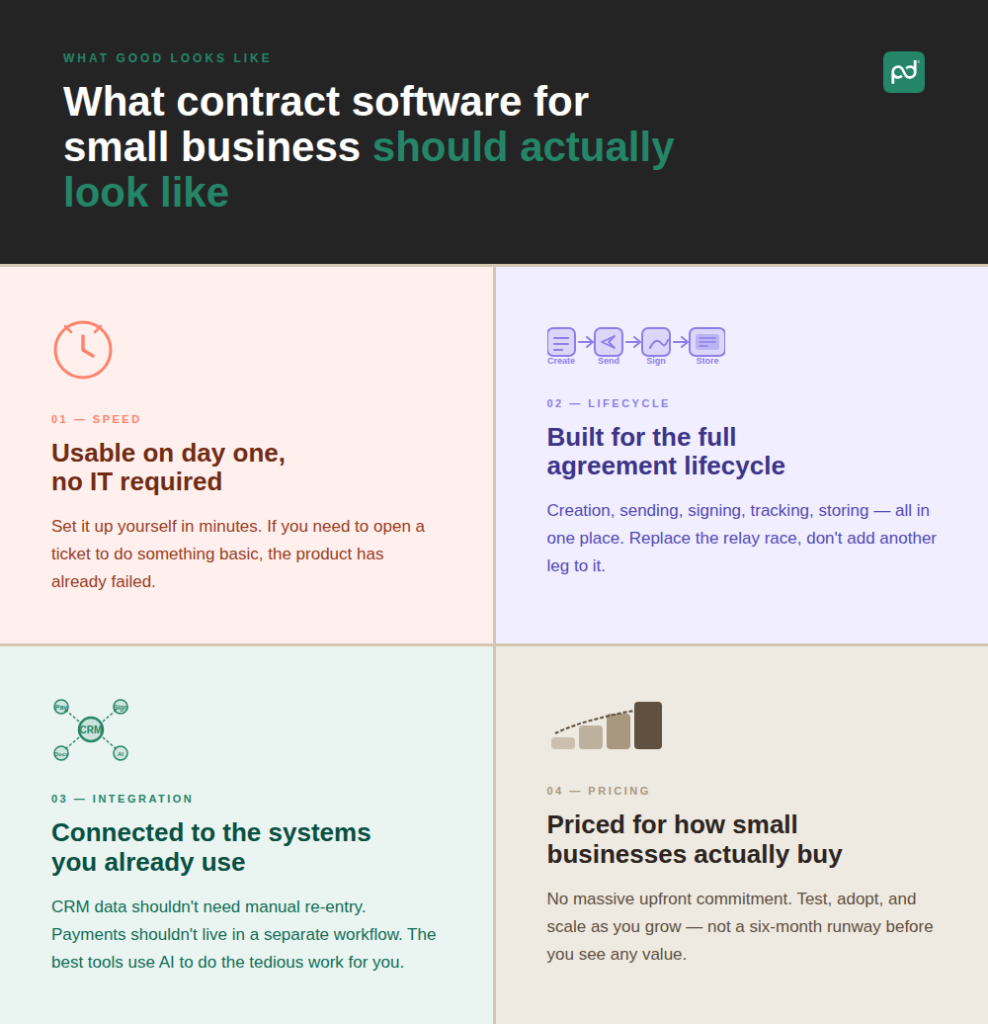
- Usable on day one, no IT required: You shouldn’t need an implementation plan to send a contract. The person running the workflow should be able to set it up themselves in minutes, not months. If someone needs to open a ticket to do something basic, the product has already failed.
- Built for the full agreement lifecycle: Creation, sending, signing, tracking, storing, all in one place instead of five tools stitched together. The goal is to replace the relay race, not add another leg to it.
- Connected to the systems you already use: CRM data shouldn’t need manual re-entry. Payments shouldn’t live in a separate workflow. The eSignature part is table stakes–the integration layer is what actually saves time. And increasingly, the best tools use AI to do the tedious work for you, automatically pulling contract dates, terms, and renewal windows so you don’t have to.
- Priced for how small businesses actually buy: No massive upfront commitment just to get started. The ability to test, adopt, and scale as you grow, not a six-month runway before you see any value.
This is where the market is finally shifting. Some platforms are being built on the assumption that the people using the software are operators, not administrators. That they care about speed (not configuration) and removing complexity.
That’s exactly how PandaDoc was built. Not for legal departments managing thousands of contracts. For growing businesses that need to move fast.
Teams can send their first agreement in minutes, not weeks. Proposals, contracts, eSignatures, and payments all live in one place– connected to the tools already in your tech stack, with no IT ticket required.
PandaDoc was built for teams like yours. See how it works.
Stop trying to fit the enterprise mold
If you’ve struggled with your contract tools, it’s easy to assume the problem is internal: “Did we not roll this out correctly? Maybe the team needs more training?”
But most of the time, the problem is simple: you’re trying to use software that wasn’t designed for you.
Small businesses have been told for years to grow into enterprise tools and to accept the complexity now for the sake of scalability later. But what if that tradeoff was never necessary?
What if contract software for growing businesses could work the way your business actually operates, fast, flexible, and without the overhead?
Those tools exist now. The only question is whether you’re ready to stop settling for software that slows you down.
Try PandaDoc and see what your agreement workflow should feel like.
Frequently asked questions
-
Enterprise tools are built for buyers that small companies don’t have: legal teams, procurement departments, and IT administrators with dedicated implementation budgets.
When those roles don’t exist, adoption fails. The tool is too heavy, the learning curve too steep, and without anyone owning it internally, the software gets underused—and eventually everyone goes back to email.
-
Traditional enterprise platforms often require weeks or months for implementation. Tools built for SMBs should deliver value in hours, with a first agreement sent before the end of day one. PandaDoc is built for exactly that: teams can get up and running in minutes, with no IT involvement required.
-
Yes. PandaDoc offers a free plan that includes 60 uploaded documents per calendar year, enough for a small team to test the platform before committing. Paid plans (Essentials, Business, and Enterprise) scale with team size and usage. See all plans.