Your contracts hold answers to business-critical questions you ask every week: When does this renew? What are the payment terms? Has anyone reviewed our proposal yet? Which high‑value deals are still unsigned? Historically, getting those answers meant digging through folders, searching for keywords, chasing status in email threads, and re-entering details into spreadsheets.
AI changes that. It can capture effective dates and terms, report on recipient engagement and document status, surface renewal windows, and return the information you need in seconds — turning buried details into instant answers.
The payoff is immediate: faster decisions, fewer surprises, and way less manual work for teams already juggling 10 other responsibilities.
AI in contract management: The tools that turn contracts into answers
Many businesses manage agreements in shared drives and inboxes, turning straightforward questions into scavenger hunts. The solution is a short stack of AI contract management capabilities that work together to make contracts searchable and actionable.
- AI Data Extraction: Automatically capture fields like renewal dates, payment terms, values, parties, and other terms for easier document tracking.
- Search: Finds those fields and clauses across your entire contract repository in seconds, using precise filters or natural‑language queries.
- AI assistants: Delivers answers via conversational Q&A, summaries, and digests (e.g., “contracts expiring in the next 60 days,” “open MSAs older than 7 days”), and can trigger quick actions like extending expiration dates.
- Document analytics: Reveals real recipient engagement — who viewed your document, which sections they focused on, and where interest dropped — so you follow up with context, not guesswork.
Put simply: AI can provide valuable analytics and insights on the terms in your contracts and surface what’s happening with them right now.
With that foundation, here are five critical questions AI can answer today, from pre‑signature visibility to post‑signature control, and why they matter.
Tired of digging through contracts for answers? Try PandaDoc and keep every agreement organized and actionable in one place.
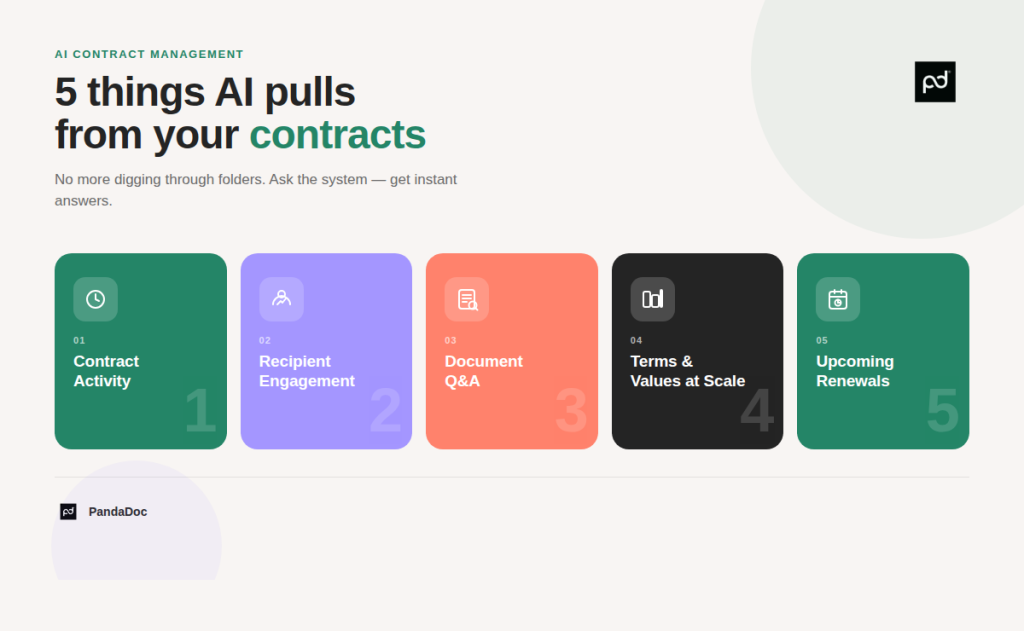
5 things AI can pull from your contracts (so you don’t have to)
1. Contract activity: What’s out for signature, where are the bottlenecks, and what changed this week?
Status clarity shouldn’t require Slack pings and CRM detective work. With AI-powered semantic search and conversational AI, you can get on-demand visibility into contract status, like every agreement out for signature. Instead of asking around, you ask the system.
Try prompts like:
- What contracts are out for signature right now over $100K?
- Show all documents expiring in the next 30 days
- Give me a digest of activity from the last 7 days
Why it matters: leaders and operators see where momentum has stalled, owners see exactly what needs attention, and end‑of‑quarter surprises give way to predictable follow‑through. It’s the difference between piecing together the picture and having the picture delivered to you.
2. Recipient engagement: Who looked, where did they focus, and what should we do next?
Sending a proposal shouldn’t mean flying blind. Document analytics show real viewing behavior, like which pages were read and for how long. “Four minutes on the pricing page and three revisits” is a very different signal than “opened once, bounced at page two.” With this context, your follow‑up becomes genuinely helpful — addressing pricing questions, packaging, or approvals — instead of a generic nudge.
Why it matters: engagement clarity reduces guesswork, helps teams tailor the next conversation, and addresses friction where it actually exists. It’s sales insight that respects the buyer’s time and your team’s.
3. Document Q&A: What, exactly, does this agreement say (without reading line‑by‑line)
Even when you know where a contract lives, finding the precise information you need can be slow. AI Assistants can answer questions directly using the document as its source, returning contextual responses and summarizing sections as needed.
Useful Q&A prompts include:
- What are the pricing and discount details in this agreement?
- Does this include a data processing addendum or specific security clause?
- Summarize the compliance and security obligations in Section 3
- Does this agreement include an opt-out clause?
Why it matters: this saves time for every team, can reduce errors from skimming or referencing the wrong version, and makes institutional knowledge shareable. Anyone can get an answer without waiting for the original drafter.
4. Terms and values at scale: What do all our contracts say?
Most teams can answer what one contract says; the hard part is answering what all contracts say.
AI Data Extraction converts agreement terms into structured fields, such as renewal dates, payment terms, governing law, auto‑renewal language, party names, and contract values. When combined with powerful AI search capabilities, you can query every business document in your workspace, rather than combing through them one at a time – helping you get high-impact information at scale.
Examples of portfolio checks to run:
- Show all contracts with auto‑renewal and a 60‑day notice requirement
- Which vendor contracts include net 30 payment terms?
Why it matters: clean reporting and fast decisions. Easily search for the information you care about most, like your highest value contracts coming up for renewal.
5. Renewals: What’s due in the next 60 days?
Automatic data capture identifies renewal and expiration dates, auto‑renew clauses, and notice windows, then pairs them with alerts so you see what’s due with enough lead time to influence outcomes.
That means canceling unused tools before you’re locked in, renegotiating pricing from a position of data‑driven strength, and engaging customers ahead of churn risk or raising expansion opportunities while there’s still time to shape the decision.
Read more: Automated churn risk alerts that protect your renewal revenue
Because the dates and clauses are structured, you can also run quick searches like “How many contracts renew in the next 60 days with a value over $50K?” Answers that once took days to figure out now take a moment.
Why it matters: Renewals are where money quietly slips through the cracks — on both the vendor and customer sides. With auto-extracted renewal dates and alerts, teams gain confidence that they’re always ahead of critical deadlines.
The simple formula behind all five
These five outcomes come from a combination of these core contract management tools working in tandem:
- AI data extraction turns the text inside your contracts into structured data
- AI search finds those fields and clauses across your entire library fast
- AI assistants assemble answers, so you see the whole picture without hopping between tools
- Document analytics adds real‑world engagement signals to guide your next move
Why PandaDoc for contract management (in one place)
The problem with most contract workflows isn’t a lack of tools; it’s too many of them. PandaDoc brings your agreement process into a single platform, so the contract you create, send, track, and store lives in the same place.
- Search your entire contract repository using filters to find what you need fast, whether that’s an obligation buried in an old MSA or an unsigned deal that’s gone quiet
- Ask the AI assistant for quick activity summaries or get instant help drafting follow-up content, then take action directly from the same workspace.
See document-level engagement analytics, including page-by-page visibility, so you know exactly when to follow up and what to address.
Start with the questions you’re already asking
You don’t have to redesign your process to get value from smarter contract management. If you’ve ever asked, “When does this renew?” “What did we agree on payment terms?” “Which big deals are still unsigned?” or “Did they actually read the proposal?” — you already have the use cases.
PandaDoc surfaces those answers without adding complexity to your stack, so you can act faster, follow up at the right moment, and spend less time hunting through documents.
See what’s in your contracts and what’s coming next. Try PandaDoc and turn your agreements into action.
Disclaimer
PandaDoc is not a law firm, or a substitute for an attorney or law firm. This page is not intended to and does not provide legal advice. Should you have legal questions on the validity of e-signatures or digital signatures and the enforceability thereof, please consult with an attorney or law firm. Use of PandaDoc services are governed by our Terms of Use and Privacy Policy.