
| Electronic signatures capture a person’s intent to sign a document. Digital signatures use cryptographic encryption to verify who signed and confirm the document hasn’t been altered since signing. |
What is the difference between a digital signature and an electronic signature?
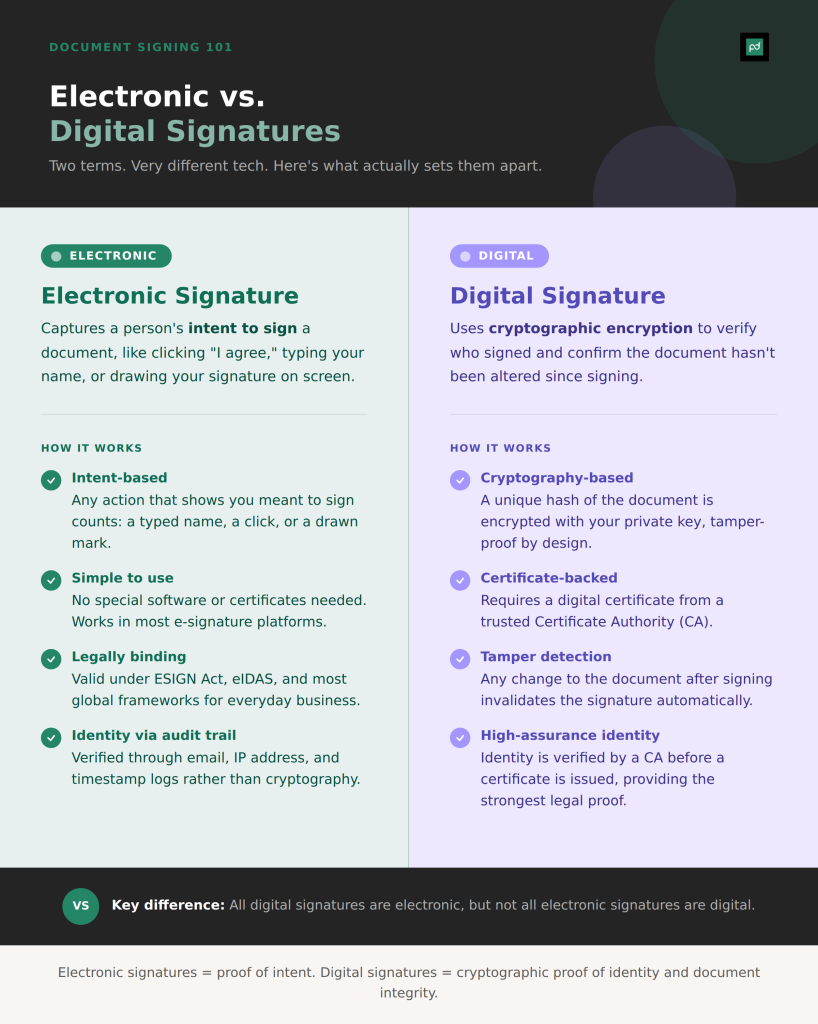
An electronic signature is any digital indication of a person’s intent to sign — a typed name, a drawn signature, a checkbox. It’s the legal act of agreeing. A digital signature is the cryptographic technology underlying it: a unique, encrypted fingerprint attached to a document that verifies who signed it and confirms nothing has changed since they did so.
The reason these terms are often confused is that most e-signature platforms — including PandaDoc — use digital signature technology under the hood to power their electronic signatures. When you sign a document in PandaDoc, you’re creating an electronic signature backed by digital signature cryptography. The result is a signature that’s both legally binding and tamper-evident.
So while every secure electronic signature relies on digital signature technology, not every digital signature is an electronic signature. The terms describe different layers of the same process — one is the legal act, the other is the security mechanism that ensures its trustworthiness.
What is an electronic signature, and how does it work?
Electronic signatures are digital representations of a person’s intent to sign a document, essentially the online equivalent of a handwritten signature. “E-signature” means the same thing: any electronic process that indicates acceptance of an agreement or record.
Electronic signatures are legally recognized in most countries. In the U.S., the ESIGN Act established its legal validity at the federal level. UETA extended that recognition across participating states. In the EU, eIDAS sets the governing standard. You don’t need cryptographic technology to create a legally valid e-signature; you need three things: clear intent to sign, a way to attribute the signature to a specific person, and a record of the signing event.
That’s why electronic signatures can take many forms and still hold up legally:
- Typing your name into a signature field
- Drawing your signature with a stylus or finger
- Clicking “I agree” or checking an acceptance box
- Entering a unique code sent to your email or phone
Each of these meets the legal standard for most business agreements, such as contracts, proposals, offers, and NDAs.
The format matters less than the evidence trail behind it: who signed, when they signed, and what they agreed to.
Essentially, an electronic signature is whatever your recipient does to confirm they’ve read and accepted the document; captured, timestamped, and stored.
What is a digital signature, and how does it work?
Where an electronic signature captures intent, a digital signature provides the technical proof behind it.
Here’s how it works. When someone applies a digital signature to a document, the software generates a unique cryptographic hash, essentially a fingerprint of that document’s exact contents. That hash is then encrypted using the signer’s private key, producing the digital signature.
Anyone who receives the document can use the signer’s public key to decrypt the signature and confirm two things: that the hash matches the document’s current state, and that the private key used to sign it belongs to the right person.
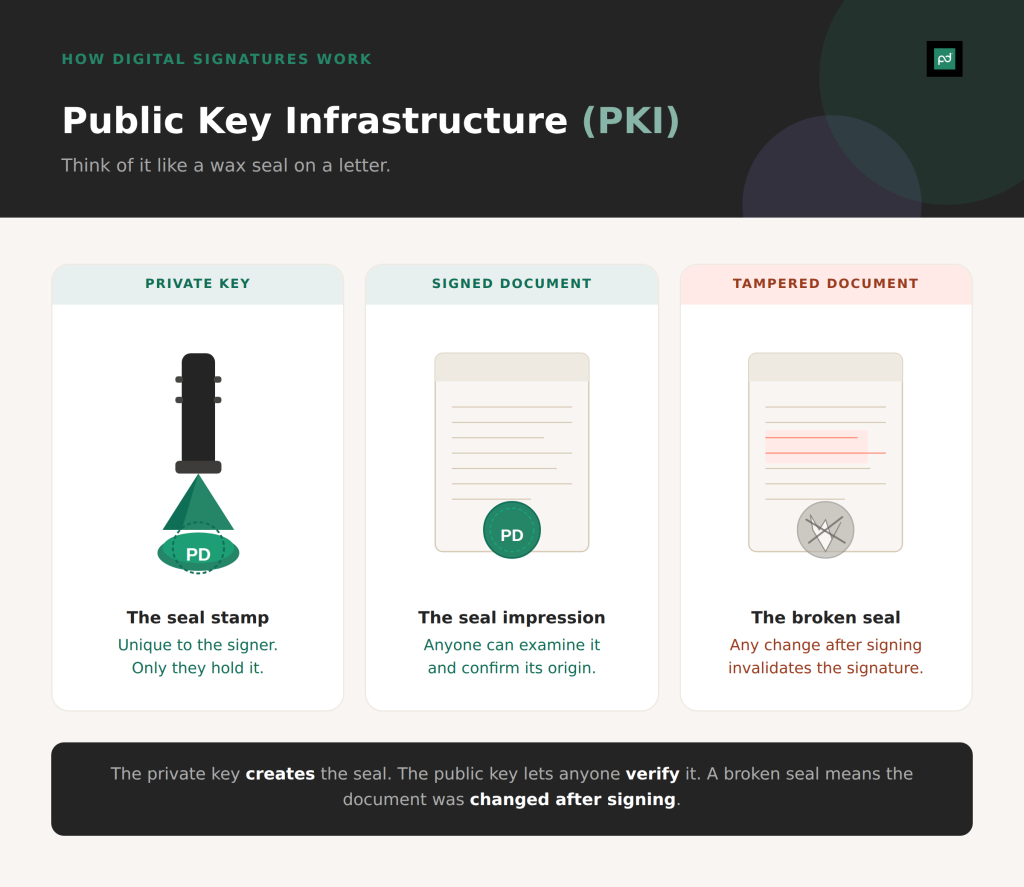
This process relies on Public Key Infrastructure (PKI). You can think of it this way:
PKI works like a wax seal on a letter. The signer’s private key is the unique seal stamp; only they have it. The public key is the impression the seal makes; anyone can examine it and confirm it came from that specific stamp. If someone tampers with the letter after it was sealed, the seal breaks. That’s what PKI does for documents: it creates a verifiable, tamper-evident seal that proves who signed and that nothing changed after signing.
For a digital signature to be trusted, it also requires a Certificate Authority (CA), a vetted third party that issues and validates the digital certificate tied to the signer’s identity. This is why digital signatures involve more setup and cost more than standard electronic signatures. You’re not just capturing a signature; you’re establishing a verified identity chain.
Together, these mechanisms give digital signatures three guarantees no standard e-signature can match on its own:
- Authentication: the signer’s identity has been verified
- Integrity: the document hasn’t been altered since signing
- Non-repudiation: the signer can’t later deny they signed it
These guarantees make digital signatures the standard in high-security contexts, such as financial transactions, legal agreements, pharmaceutical approvals, and software distribution. For organizations operating under strict regulatory requirements, qualified electronic signatures built on this technology meet the highest legal requirements.
When to use a digital signature vs an electronic signature
The two technologies are complementary. But they serve different purposes, and using the wrong one for a given context can create compliance gaps or unnecessary friction for your counterparty.
The governing distinction is that electronic signatures meet the legal standard when proof of intent and a complete audit trail are sufficient. Digital signatures are required when a legal or regulatory standard explicitly demands cryptographic proof of identity and tamper evidence, not just intent.
Use electronic signatures for standard business documents
For most business agreements, an electronic signature is legally sufficient, faster to execute, and exactly what your counterparty expects.
If a document falls under the ESIGN Act, UETA, or eIDAS’s standard electronic signature tier, and the primary requirement is a clear record of who agreed to what and when, an e-signature gets the job done.
Scenarios where electronic signatures are the right call:
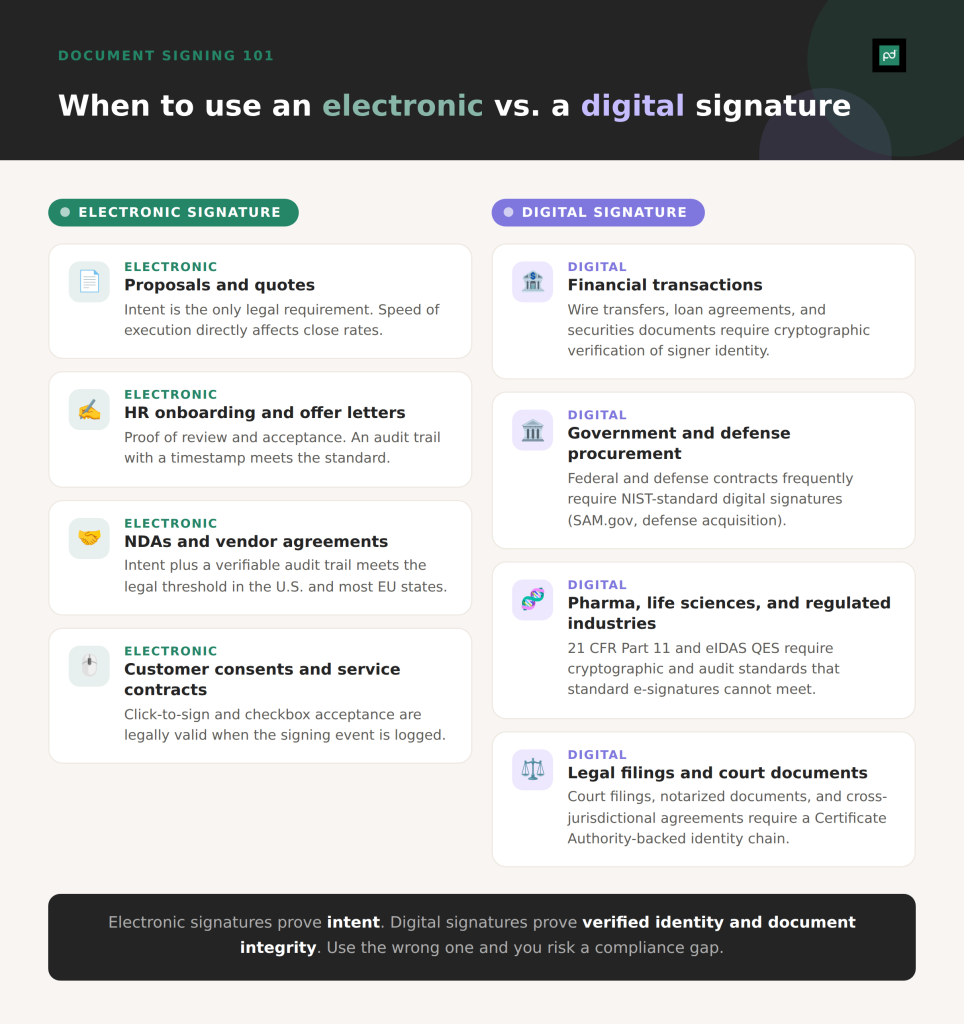
- Proposals and quotes. PandaDoc’s core use case. Your buyer signs to confirm acceptance — intent is the only legal requirement, and speed of execution directly affects close rates.
- Hiring and onboarding documents. Offer letters, benefits elections, and policy acknowledgments require proof that an employee reviewed and accepted the terms. An audit trail with a timestamp satisfies that standard.
- NDAs and general contracts. For most commercial NDAs and service agreements between businesses, intent plus a verifiable audit trail meets the legal threshold in the U.S. and most EU member states.
- Customer agreements and consent forms. Click-to-sign and checkbox acceptance are legally valid for terms of service, privacy consents, and similar agreements, provided the signing event is logged.
- Vendor agreements and procurement documents. Supplier onboarding, purchase orders, and standard vendor contracts operate at a risk level where electronic signatures are commercially accepted and legally sufficient.
- Service contracts. For ongoing service agreements where both parties are known and the counterparty relationship is established, electronic signatures enable fast execution without sacrificing legal standing.
Use digital signatures when documents require cryptographic verification
Some documents operate under legal or regulatory frameworks that go beyond intent.
They require proof that a specific, verified individual signed, and that nothing changed after they did. Digital signatures are required for these use cases.
Scenarios where digital signatures are the right call:
- Financial transactions. Wire transfers, loan agreements, and securities documents often fall under regulatory frameworks that require cryptographic verification of signer identity, not just a record of consent.
- Government and defense procurement. Federal contracting and defense agreements in the U.S. frequently require digital signatures that meet NIST standards, particularly for documents submitted through systems such as SAM.gov or within defense acquisition workflows.
- Cross-border EU agreements requiring QES. Under eIDAS, certain high-stakes agreements require a qualified electronic signature, the highest legal tier, built on digital signature technology issued by an EU-approved trust service provider.
- Pharmaceutical and life sciences documents. 21 CFR Part 11, the FDA’s regulation governing electronic records, requires that signatures on regulated documents meet specific cryptographic and audit standards. Digital signatures satisfy this requirement; standard electronic signatures typically do not.
- Software code signing. Developers use digital signatures to verify that code is authentic and hasn’t been modified between release and installation, the same tamper-evidence requirement that governs high-stakes legal and financial documents applies to software distribution.
Legal filings in high-stakes proceedings. Court filings, notarized documents, and cross-jurisdictional legal agreements often require a verifiable identity chain that only a Certificate Authority-backed digital signature can provide.
Compliance scenarios: when the law specifies which type of signature you need
For most business documents, you can choose between an electronic signature and a digital signature based on your workflow and risk tolerance. For some documents, that choice is made for you.
The regulations below define which specific industries and transaction types are required. This section reflects what each regulation generally requires; consult your legal counsel to determine what applies to your specific situation.
eIDAS and the EU: when you need a QES
eIDAS, the EU’s governing framework for electronic signatures, establishes three tiers of legal recognition. Which tier a document requires depends on the transaction’s risk level and, in some cases, the member state in which it’s executed.
- Simple electronic signature (SES). Any electronic indication of agreement, including a typed name, a checked box, or a click. Valid for low-risk, everyday documents where the primary requirement is a record of consent.
- Advanced electronic signature (AES). Uniquely linked to the signer, capable of identifying them, and created using data under the signer’s sole control. Carries greater legal weight and is appropriate for documents where signer attribution matters more than in a standard commercial agreement.
- Qualified electronic signature (QES). The highest tier under eIDAS is legally equivalent to a handwritten signature across all EU member states. Requires a qualified certificate issued by a trust service provider on the EU Trust List.
Business scenarios that commonly require QES include some EU employment contracts, real estate transactions in specific member states, regulated financial services documents, and cross-border legal agreements where full legal equivalence to a handwritten signature is required.PandaDoc supports qualified electronic signatures for organizations operating under eIDAS requirements.
ESIGN, UETA, and U.S. law: what electronic signatures can and can’t do
Under the ESIGN Act and UETA, electronic signatures are valid for most commercial transactions in the United States. For most business agreements, such as contracts, proposals, vendor agreements, and employment documents, a standard electronic signature with a complete audit trail meets legal requirements.
There are exceptions. ESIGN and UETA explicitly carve out certain document types where a handwritten signature is still required:
- Wills and codicils
- Adoption documents
- Divorce agreements
- Court orders
- Certain notices under the Consumer Credit Law
For these, no electronic signature, regardless of how it’s secured, substitutes for a wet signature.
Healthcare. HIPAA does not prohibit electronic signatures and does not mandate digital signatures for most healthcare transactions. It requires that your signing process maintain an appropriate audit trail and access controls consistent with your organization’s security obligations. What that means for a specific document or workflow is a question for your compliance officer or legal counsel, not a determination to make based on general guidance.
Government and federal contracts. Many U.S. federal agencies require digital signatures backed by a PKI-based certificate in accordance with FISMA and NIST standards. State and local requirements vary significantly. If your organization works with federal contracting vehicles, confirm the signature requirements with the contracting officer before executing.
21 CFR Part 11: life sciences and pharmaceutical
FDA’s 21 CFR Part 11 governs electronic records and electronic signatures in the life sciences and pharmaceutical industries. Under Part 11, electronic signatures are permitted, but they must meet specific technical requirements. Each signature must be unique to the individual, under that individual’s sole control, and linked to the electronic record it applies to.
Many pharmaceutical and life sciences companies use digital signatures for Part 11 compliance. The cryptographic controls digital signatures provide, verified identity, tamper-evidence, and a complete audit trail, satisfy Part 11’s requirements for uniqueness and control in a way that standard electronic signatures may not, depending on implementation.
PandaDoc serves life sciences and pharmaceutical organizations operating under 21 CFR Part 11 requirements.
Are digital and electronic signatures legally binding?
Are digital and electronic signatures legally binding?
Yes — both are legally binding in most parts of the world, including for automated signatures. But “legally binding” isn’t a feature a signature type has on its own. It’s a determination courts and regulators make based on the evidence behind the signature.
Three things establish the legal validity of an e-signature: proof that the signer intended to sign, evidence that the signature can be attributed to a specific person, and confirmation that the document hasn’t been altered since signing.
Both electronic and digital signatures can satisfy all three. Digital signatures provide a higher-assurance version of that evidence through cryptographic proof, but for most business agreements, a well-documented electronic signature meets the standard.
In the U.S., the ESIGN Act and UETA confirm the enforceability of electronic signatures for most commercial transactions. In the EU, eIDAS governs electronic and digital signatures, with qualified electronic signatures carrying the highest legal weight.
PandaDoc’s platform is compliant with:
- ESIGN Act (U.S.)
- UETA (U.S.)
- eIDAS (EU)
- SOC 2 Type II standards
Some exceptions apply. In the U.S., certain document types, including wills, adoption papers, divorce agreements, and some voter registration and tax forms, still require a handwritten signature.
Digital vs. Electronic Signatures
| Feature | Digital Signature | Electronic Signature |
| Purpose | Verifies authenticity and prevents tampering | Shows intent to sign a document |
| Technology | Uses encryption and certificates | Typing, clicking, drawing, or other digital inputs |
| Security level | Very high — cryptographic validation | Moderate — security depends on implementation |
| Common uses | Financial docs, legal filings, code signing | HR forms, sales contracts, consent forms |
| Legally binding? | Yes, under global laws | Yes, under ESIGN, UETA, eIDAS, etc. |
| Regulatory framework | eIDAS (QES tier), FISMA/NIST, 21 CFR Part 11 | ESIGN, UETA, eIDAS (SES/AES tiers) |
| Setup required | Certificate Authority, digital certificate, PKI infrastructure | Email, name, or click — no technical setup required for signers |
Final thoughts
Electronic signatures and digital signatures aren’t interchangeable terms. One captures intent; the other verifies identity and document integrity.
For most business agreements, an electronic signature with a complete audit trail is exactly what you need. For regulated industries and high-stakes transactions, digital signature technology enhances assurance to meet stricter legal standards.
PandaDoc supports both. Our built-in e-signatures are legally compliant with ESIGN, UETA, and eIDAS, and we support qualified electronic signatures for organizations that require the highest level of legal recognition. Whether you’re sending a proposal, closing a deal, or executing a regulated agreement, you can do it from one platform.
Ready to see it in action? Try PandaDoc or Book a free demo, and we’ll walk you through it.
Disclaimer
PandaDoc is not a law firm, or a substitute for an attorney or law firm. This page is not intended to and does not provide legal advice. Should you have legal questions on the validity of e-signatures or digital signatures and the enforceability thereof, please consult with an attorney or law firm. Use of PandaDocs services are governed by our Terms of Use and Privacy Policy.
Originally published August 30, 2016, updated June 12, 2025
Frequently Asked Questions
What is the difference between a digital signature and an electronic signature?
An electronic signature is any digital indication of a person’s intent to sign a document, such as a typed name, a drawn signature, or a click. It’s the legal act of agreeing. A digital signature is the cryptographic technology underneath: an encrypted fingerprint attached to a document that verifies who signed it and confirms nothing has changed since they did.
Most e-signature platforms, including PandaDoc, use digital signature technology under the hood to secure the electronic signatures your recipients see and interact with.
Is a digital signature more secure than an electronic signature?
Digital signatures provide a higher level of assurance because they rely on cryptographic encryption to verify the signer’s identity and confirm the document hasn’t been altered since signing.
A standard electronic signature establishes intent and produces an audit trail, which is sufficient for most business agreements. Digital signatures add a layer of cryptographic proof that makes them the standard for regulated industries and high-stakes transactions where tamper-evidence is a legal or contractual requirement.
When should I use a digital signature instead of an electronic one?
Use a digital signature when the legal or regulatory standard for a document explicitly requires cryptographic verification of identity and tamper-evidence, not just a record of intent. Common scenarios include federal government contracts under FISMA and NIST standards, pharmaceutical and life sciences documents under 21 CFR Part 11, regulated financial transactions, and cross-border EU agreements requiring a qualified electronic signature under eIDAS. For most standard business agreements, such as proposals, NDAs, service contracts, onboarding documents, an electronic signature with a complete audit trail meets the legal standard.
What is the difference between a digital signature and a qualified electronic signature?
A qualified electronic signature (QES) is a specific type of digital signature, the highest tier of legal recognition under the EU’s eIDAS regulation. All QES are built on digital signature technology, but not all digital signatures meet the QES standard.
To qualify, a signature must be created using a qualified certificate issued by a trust service provider on the EU Trust List. A QES is legally equivalent to a handwritten signature across all EU member states, making it the required standard for certain employment contracts, real estate transactions, and regulated financial agreements in the EU.
Does HIPAA require a digital signature?
HIPAA does not mandate digital signatures for most healthcare transactions. Electronic signatures are permitted under HIPAA, provided your signing process maintains the access controls and audit trail requirements consistent with your organization’s security obligations.
Some healthcare organizations use digital signatures for higher-security documents because the cryptographic controls satisfy those requirements more comprehensively. What your specific workflows require is a determination for your compliance officer or legal counsel, the guidance here reflects what the regulation generally requires, not advice for your specific situation.
What does eIDAS require for contracts in the EU?
eIDAS establishes three tiers of electronic signature, each carrying different legal weight.
- A Simple Electronic Signature (SES) a typed name or checkbox — is valid for low-risk documents.
- An Advanced Electronic Signature (AES) is uniquely linked to the signer and carries higher legal weight for documents where attribution matters.
- A Qualified Electronic Signature (QES) is the highest tier, legally equivalent to a handwritten signature across all EU member states, and requires a certificate from a trust service provider on the EU Trust List.
For contracts where full legal equivalence to a handwritten signature is required, a qualified electronic signature is the standard eIDAS specifies.