Growing businesses run on agreements, but for many teams, managing those agreements feels like drowning in a sea of messy folders and scattered PDFs. This leads to issues such as slow turnaround times, duplicate work, and hidden compliance risks, and this problem escalates over time.
Years of contracts sit locked away in legacy systems, creating blind spots that compound as your business grows. Without visibility into every agreement, teams can’t spot patterns, track obligations, or learn from past negotiations.
AI data extraction solves these challenges by turning static documents into structured, searchable data your teams can act on, whether those contracts were signed yesterday or five years ago. In this guide, we’ll explore exactly what AI data extraction is, why it delivers transformative value for growing businesses, and what features to prioritize when evaluating solutions.
What is data extraction AI?
AI data extraction automatically identifies, captures, and structures key information from documents, such as effective dates, renewal terms, fees, and counterparties, without a person having to read every page. It turns hours of manual work into minutes of automated document processing.
AI data extraction works across the full spectrum of documents:
- Structured Data: Consistently defined information with standardized layouts or fixed form fields (e.g., W-9s, web forms)
- Semi-structured data: Documents with repeating but flexible layouts, like invoices from different vendors
- Unstructured data: Free-form text and varied layouts, such as emails, contracts, statements of work, or scanned PDFs
Because AI models learn patterns, entities, clauses, tables, and relationships, accuracy improves as you process more documents, creating a system that continues to learn and improve.
How AI understands your documents
AI data extraction uses several advanced technologies working in tandem:
- Optical Character Recognition (OCR): Converts scanned documents into machine-readable text
- Natural Language Processing (NLP): Understands context, entities, and meaning within documents (e.g., “governing law,” “auto-renew”)
- Machine Learning (ML): Continuously improving accuracy based on patterns and feedback
- Computer Vision: Interprets document layouts, tables, and visual elements
The manual contract crisis that’s causing you pain
Businesses of every size face this challenge, but it hits small and medium-sized businesses (SMB) particularly hard, since many have yet to adopt dedicated platforms to manage their agreements. They juggle contracts across spreadsheets and email threads, making visibility, version control, and renewals nearly impossible to manage at scale.
The numbers don’t lie
Recent research by PandaDoc reveals the scope of the problem*
- 84% of respondents experience time and efficiency problems when handling their agreements
- 48% cite manual and chaotic processes as their primary pain point
- Only 52.3% of non-Contract Management Software (CMS) users express satisfaction with their current setup
- Non-CMS users show a 5x higher dissatisfaction rate compared to CMS users
This manual chaos slows down deals and hides critical business data in plain sight.
“We had them on SharePoint, we had them in Google, we had them in emails. It was not a very secure or cohesive way to have all of our different contract renewals.” – PandaDoc user
“Our system relies heavily on human beings to remember where we are in the contract life cycle AND to keep track of contracts via email. It’s crazy!!!” – PandaDoc user
*All statistics in this section come from PandaDoc’s research with businesses in the 2-50 employee range, representing the core SMB market where these challenges are particularly acute.
Why this matters
- Fragmentation kills speed and accuracy: Tracking renewals and key dates across multiple locations increases the likelihood of missed obligations and last-minute scrambles
- Double work drags productivity: Teams manually enter and re-enter the same data into multiple systems just to keep records in sync
- Risk compounds with volume: As monthly contracts grow, manual methods break — especially for security, auditability, and handoffs between teams
Learn how you can automate contract renewals with templates and CRM triggers.
Enter AI data extraction
AI automatically pulls the critical information from your documents. Instead of data living trapped in static PDFs, AI transforms your documents into actionable business intelligence that works for you by automating capture, reducing errors, and accelerating every downstream workflow.
AI data extraction vs traditional methods
For years, organizing agreement data meant opening a PDF, finding the expiration date or contract value, and typing it into a spreadsheet. That approach is slow, error-prone, and impossible to scale as volume and document types grow.
Imagine doing that for every agreement your business has ever signed; you’d likely give up quickly because it’s simply not manageable. Critical information slips through the cracks. Renewal dates get missed. Standard obligations go unnoticed.
“Our CFO just wanted much better visibility and notification so that all the important parties were notified if we had some of our larger contracts coming up for renewal where we still had ample time to negotiate or opt out.” — PandaDoc user
The manual method breakdown
- Tedious and inconsistent: Manual tagging gets skipped because it takes too much time, leaving repositories to drift into disorder
- High risk of error: Simple copy-paste mistakes or typos on key dates can lead to missed obligations
- Insurmountable backlog: Retro-tagging thousands of historical documents is unscalable.
- Fragmentation pain: PandaDoc’s research shows 75% of businesses use 2+ storage locations, with satisfaction dropping significantly as fragmentation increases
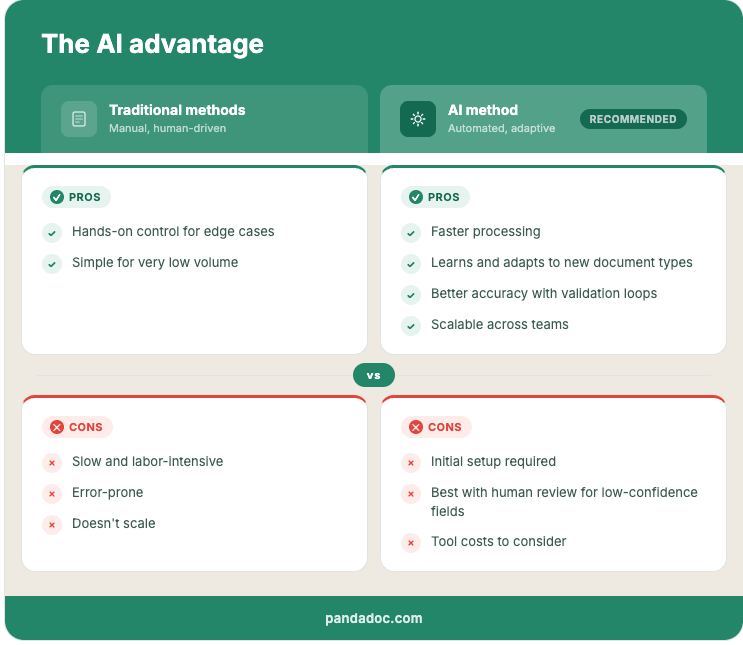
The bottom line: AI turns extraction from a brittle, manual task into a resilient, continuously improving capability that scales with your business.
Benefits of AI data extraction for businesses
Moving to an AI-powered workflow offers transformative advantages that are reshaping how businesses operate. With 78% of organizations now using AI in at least one business function, the pressure to adopt is intensifying.
Faster processing and turnaround
Process documents in minutes instead of days, accelerating approvals, invoicing, and renewals. Your repository becomes instantly searchable by fields, not just file names.
Reduced human error
Eliminate repetitive data entry and the copy-paste mistakes that come with it. Free teams to focus on exceptions, negotiation, and strategic outcomes.
Better compliance
Automatically identify and track renewal dates to avoid unwanted auto-renewals or missed renegotiation windows. This proactive approach protects revenue and ensures regulatory compliance.
Scalability across teams
As document volume increases, AI remains consistent. Whether you manage 5 contracts or 500, the effort required to organize them stays the same — giving you the infrastructure you need to scale.
How does data extraction AI work? How to use AI to extract data?
You don’t need to be a data scientist to use AI extraction.
Modern tools make the process straightforward.
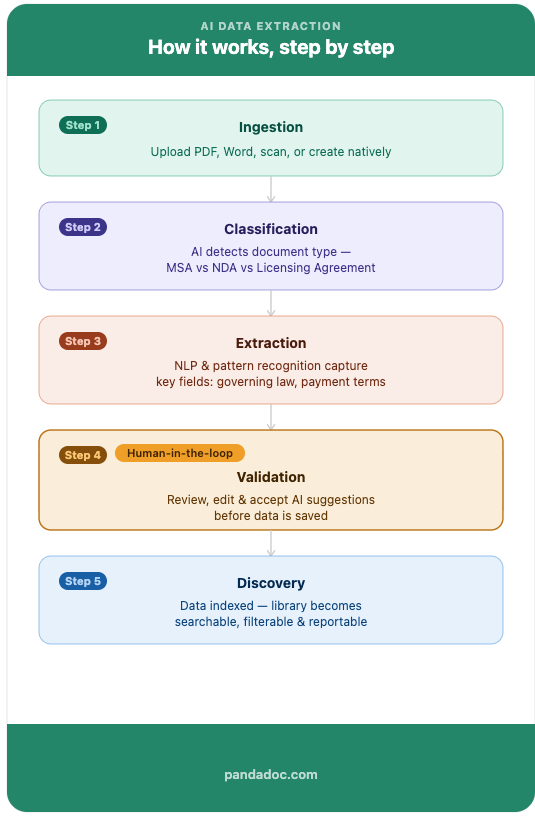
Ingestion
Upload a document (PDF, Word, or even a scan) or create one natively within your document platform.
Proposal software vs. Word + PDF: Close deals faster with the right tool
Classification
AI automatically detects the document type, distinguishing an MSA from an NDA from a Licensing Agreement. This determines the relevant data fields to extract.
Extraction
The engine scans the text to identify and capture data fields, from governing law to payment terms, using advanced NLP and pattern recognition.
Validation
A “human-in-the-loop” interface — if your tool has one — allows you to review, edit, and accept the AI’s suggestions, ensuring accuracy before the data is saved.
Discovery
Once verified, the data is indexed, making your entire document library searchable, filterable, and reportable.
AI data extraction tools
There are numerous AI data extraction platforms, each with unique strengths. The key is finding one that matches your business size, technical requirements, and growth trajectory.
The market spans from enterprise legal platforms to user-friendly, all-in-one solutions. Here’s how to navigate your options.
Enterprise platforms
Built for large legal, procurement, and operations teams with complex workflows.
Ironclad
Comprehensive CLM with advanced AI extraction, ideal for enterprise legal departments managing high-volume, complex agreements.
Icertis
Enterprise-grade contract intelligence platform with sophisticated AI capabilities and extensive customization options.
Conga
End-to-end contract lifecycle management with robust extraction features, popular among large sales organizations
Legal-focused, AI-native tools
Specialized solutions for AI-savvy legal professionals.
Ivo.ai
New AI-powered tool specifically designed for legal teams, focusing on contract review and risk analysis, must be integrated with a separate CLM
Kira Systems
Advanced machine learning for contract analysis, used by law firms and legal departments
User-friendly solutions
Designed for teams that need enterprise power with intuitive simplicity.
PandaDoc
Easy-to-use platform offering document creation and management tools without enterprise complexity.
Contractbook
SMB-focused contract management tool with AI extraction, contract volumes are limited by plan
Concord
Simple CLM with solid extraction capabilities for mid-market companies
What to look for in AI data extraction tools
Finding the right AI data extraction solution doesn’t have to be overwhelming.
Here are the key features that separate great tools from the rest.
Accuracy across diverse formats
Look for tools with strong OCR capabilities, smart layout recognition, and the ability to spot important clauses and entities across different document formats. The best solutions handle everything from pristine PDFs to messy scanned contracts and legacy documents from years past with equal confidence. This ensures you can digitize and extract value from your entire contract history, not just new documents.
Gets smarter over time
Choose platforms that let you fine-tune extraction for your specific document types and actually learn from your feedback. The ideal tool improves its accuracy as you use it, creating a system that becomes increasingly valuable.
Keeps humans in control
Great AI extraction tools know when to ask for help. Look for features like extraction validation checks, custom data field creation, role-based access controls, and data retention policies. You want AI that’s powerful but still gives you oversight and governance.
Integrates with critical tools
Your Contract Lifecycle Management (CLM) or extraction tool should connect seamlessly with your existing systems through APIs or pre-built integrations. Data portability is crucial; you don’t want to be locked into a single platform forever.
Easy to use and quick to value
Skip tools that require months of setup or a computer science degree to operate. The best solutions offer intuitive interfaces, minimal technical requirements, and get you results fast. Be wary of any platform that requires a consultant to help you migrate and adopt.
Complete lifecycle coverage
Consider all-in-one platforms that handle everything from contract creation and negotiation through signature, storage, and renewal management. Why juggle multiple tools when you can have one solution that manages your entire document lifecycle with integrated AI extraction?
The sweet spot? A platform that combines enterprise-grade AI capabilities with user-friendly design and comprehensive lifecycle management — giving you powerful extraction without the complexity.Turn documents into data — then outcomes
AI data extraction eliminates the manual work that traps your most critical data in static tools, ensuring you never miss critical deadlines and giving your team valuable time back to focus on what matters most.
Ready to take control of your contracts? Start your PandaDoc trial and manage every agreement in one place.
Frequently asked questions
-
AI improves compliance by ensuring that no critical term or date is missed. By automatically extracting obligations and renewal dates, the system can proactively alert you before a contract expires, preventing financial loss from missed renegotiations.
Advanced AI systems can also flag potential compliance issues and inconsistencies across your document portfolio, with businesses reporting significant improvements in regulatory adherence.
-
Modern AI uses Natural Language Processing (NLP) to understand the context and relationships within a document. This allows it to “read” through legal jargon and messy formatting to find the specific data points your business needs to track, transforming unstructured text into a structured, searchable database.
These systems can handle multi-page tables, handwritten notes, and documents with varying layouts — all while maintaining high accuracy rates exceeding 96%. The technology has evolved to process both structured data (like form fields) and unstructured data (like complex legal agreements) with equal effectiveness.
Disclaimer
PandaDoc is not a law firm, or a substitute for an attorney or law firm. This page is not intended to and does not provide legal advice. Should you have legal questions on the validity of e-signatures or digital signatures and the enforceability thereof, please consult with an attorney or law firm. Use of PandaDoc services are governed by our Terms of Use and Privacy Policy.