

Say an operations manager is reviewing expenses when they discover that a vendor contract just auto-renewed. This happened because it was buried deep in a shared Drive folder without a reminder set.
Because no one flagged the renewal date, the team is now locked into paying for this vendor for another year, which they intended to renegotiate.
Most teams think of a contract repository as a storage problem. In reality, it’s a searchability, auditability, and renewal intelligence problem. In this post, we’ll break down the three core jobs that a contract repository needs to perform, plus what will happen when it only does one of them.
Key takeaways:
- Modern contract repositories keep contracts secure and available through centralized, digital spaces.
- Minimize mistakes, time-wasting, and accuracy issues by utilizing a contract repository.
- Guarantee security and compliance by centralizing your contracts.
- Enjoy all the benefits of a contract repository as part of a comprehensive contract management system.
Customize, negotiate, and eSign complex contracts with PandaDoc.
What is a contract repository? (And what it isn’t)
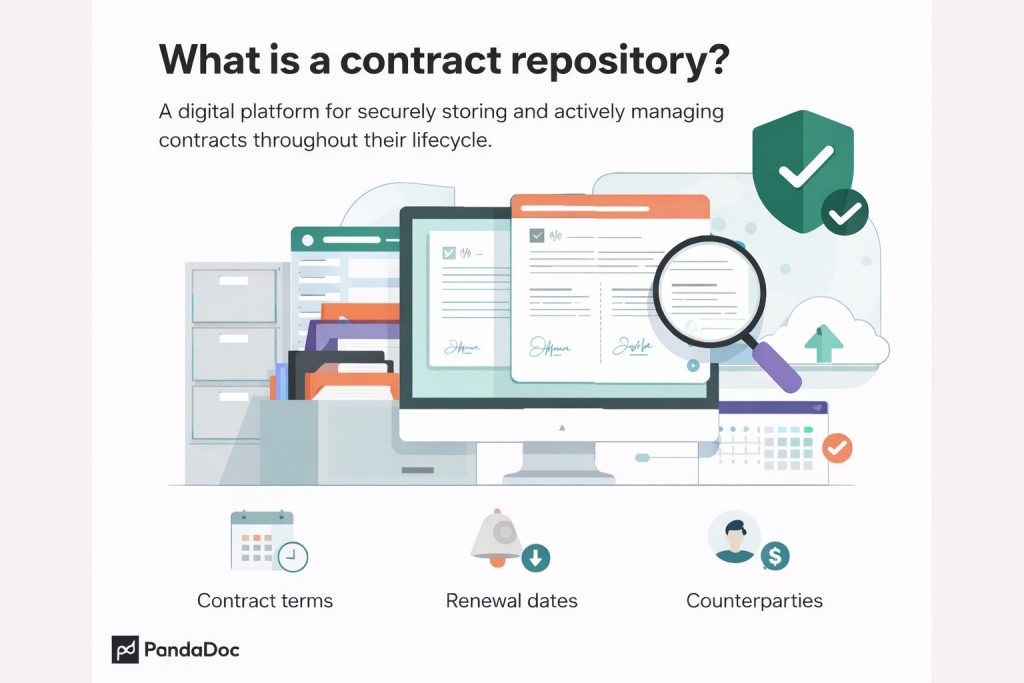
Contract repository management is the practice of storing, organizing, and actively managing contracts in a centralized digital system, enabling teams to search by clause or counterparty, track obligations and renewal dates, and maintain a clear audit trail without opening individual files.
Essentially, it’s a core function of contract management. It’s also closely tied to contract lifecycle management.
The whole point of contract repository management isn’t just to store contracts. You want them to be usable, visible, and actionable across your business.
That means that it isn’t a shared drive folder labeled “Contracts.” This is common, but it’s a system that lacks structured metadata, automated tracking, and version governance.
This makes it nearly impossible for you to monitor key terms, enforce obligations, or meet renewal deadlines.
The impact of poor contract management is significant, costing businesses an average of 9.2% of annual revenue, according to World Commerce and Contracting.
What’s more is that in organizations without centralized systems, an estimated 10% of contracts go missing entirely, according to Faulkner Information Services. This means more financial and compliance risk.
The three jobs a contract repository actually needs to do
Every contract repository stores documents. That’s table stakes. Any shared drive, folder system, or document tool can do that.
What makes a functional repository different from being a simple digital filing cabinet is searchability, auditability, and renewal intelligence.
These three jobs matter tremendously in how contracts are used across the entire business. Ops needs to find information quickly (searchability), legal and compliance teams need a defensible record of what’s happened (auditability), and finance and procurement teams need to see key dates and financial commitments (renewal intelligence).
If one person is responsible for all three, as is often the case in practice, having a system that makes it manageable is critical.
Here’s what a system like that would actually look like.
1. Searchability: Find any clause in seconds, not hours
Most teams aren’t struggling with storage; they’re struggling with retrieval. In fact, 71% of companies report they can’t locate 10% or more of their contracts, according to the Journal of Contract Management via Summize.
Shared drives have the problem that search only works when you remember the filename. So if you don’t remember what the file was called or what it contained, you’ll be stuck opening files one by one.
A contract repository is different in that it makes contracts fully searchable and filterable. So, instead of having to rely on filenames, you can search by full text or even apply structured filters like:
- Counterparty
- Contract value
- Effective date
- Renewal window
- Jurisdiction
- Contract type
- Department, ownership, and signatories
- Key dates and conditions
These systems also use AI in contract management to automatically extract this kind of data on upload. It can extract clauses, dates, and counterparties without manual entry, which means less time spent tagging contracts and fewer human errors.
Metadata makes it easier to identify information about the contracts within the repository. Forms of metadata contained in a repository might include:
- The form of contract.
- The condition of the contract (active, inactive, terminated).
- The department that a contract relates to.
- Significant dates.
- List of signatories.
- The ownership of a contract.
- Additional contextual information.
Consider the difference in a real-world scenario. Say a legal ops manager needs every NDA with an auto-renewal clause that expires in the next 90 days. With a repository, you can find those contracts in a few seconds using a filtered search, avoiding hours of manual review in a folder-based system.
2. Auditability: Know who changed what, and when
Contracts evolve through drafts, approvals, and negotiations, which means they aren’t static documents. If you don’t have a clear record of those changes, you could lose the ability to verify what was agreed to and how.
Here’s why auditability matters across departments:
- Procurement needs to prove pricing and terms were approved at the right level
- Finance needs to trace the agreed payment terms
- HR needs to confirm which version of a contractor agreement was signed
- Legal needs to demonstrate compliance during audits
A proper contract repository will have a complete audit trail, including:
- Timestamped records of every view, edit, approval, and signature
- Version history with the ability to restore prior versions
- Verified signer identities tied directly to the document record
Fundamentally, this is a different system than the version chaos you get in shared drives. For example, files that are labeled “v1,” “v2,” “FINAL,” or “FINAL_ACTUAL.” These don’t provide real governance or accountability.
There are also direct compliance implications to consider. Audit trails are a prerequisite for frameworks like SOC 2, HIPAA, and GDPR-adjacent reviews. Having a repository removes the manual process that’s prone to errors and wasted time.
3. Renewal intelligence: Stop missing the dates that cost money
The most expensive contract failures are usually the ones that you don’t even notice.
For example, the vendor agreement auto-renewed because no one was notified as the date approached. If your team misses the window to renegotiate, you could get locked into another 12 months of paying at a rate that could have been challenged.
The problem isn’t negligence. It’s that renewal dates are buried inside documents that nobody has a reason to reopen until it’s too late.
Renewal intelligence solves this issue.
A contract repository can:
- Track key dates like renewal deadlines, notice periods, and review windows
- Send automated alerts ahead of those deadlines
- Route smart reminders to the right person
- Show you upcoming renewals in a centralized dashboard view
The distinction is that a shared drive can store a renewal date in a filename, whereas a contract repository can track it, surface it proactively, and make sure it gets to the right person before the decision window closes.
How does a contract repository integrate with your current systems?
A contract repository system is a centralized digital platform for securely storing and managing contracts, operating as a seamless extension of your existing workflows.
The right system should integrate with your CRM, document management tools, and other business applications to keep contract processes smooth and connected.
PandaDoc makes this easy by integrating with CRMs so you can generate, store, and manage contracts directly within the platforms you already use.
Features like metadata tagging, version control, and role-based access ensure secure, organized, and efficient contract management—all without disrupting your workflow.
How do you set up a contract repository?
Setting up a contract repository begins by finding the right solution.
Many different providers are available, and you also have a choice of a pure repository and broader contract software.
It’s vital you choose a provider with a strong reputation.
This will give you the best chance of selecting reliable, user-friendly software with the features you need.
Having identified potential suppliers, you can take two main routes.
Repository-only solution
For many businesses, all that might be needed is a pure repository for your contracts.
This includes features to make contract access and storage easier and more secure.
We’ll explore the bells and whistles these provide in the next section.
Repository software as part of a wider package
You also have the option to choose a solution that includes a repository as part of a broader contract management package.
If you select this option, you’ll get all the standard features of a repository.
In addition to these, the best contract management software helps you automate contract creation.
It will provide templates, workflows, eSignature functionality, and more.
The route you choose will depend on your organization’s needs and the available budget.
What to evaluate when choosing a contract repository
Remember that not all contract repositories will have the same capabilities. When you’re evaluating your options, look for features that support your long-term contract management.
Here are some stand-out features to consider:
- AI data extraction accuracy: Look for a platform that can reliably extract key contract data, such as dates, terms, values, and obligations, with minimal manual correction. Accuracy matters, especially at scale.
- Renewal and obligation automation: Whatever repository you choose, it should automatically track renewals, expirations, and contractual obligations, with configurable alerts. This will help you stay compliant and avoid missed deadlines.
- Reporting and contract analytics: If you choose a repository with built-in reporting and analytics, you’ll have an easier time analyzing vendor relationships, contract spend, risk exposure, and performance trends across your contract portfolio.
- CRM and ERP integrations: Native integrations with CRM, ERP, and finance systems will allow your contract data to flow seamlessly across your business. This helps with sales, procurement, and financial workflows.
- Security, audit trails, and compliance certifications: Make sure your repository has strong security controls, detailed audit logs, and recognized compliance certifications. These are essential for protecting sensitive contract data and meeting regulatory requirements.
Contract repository vs basic document storage
General document storage tools can store contract files, but they lack the contract intelligence and lifecycle management that contract repositories provide. A dedicated contract repository will be better for managing contract data, obligations, and risk.
Here’s a quick comparison.
| Role-based permissions at the document and folder level | Contract repository | Basic document storage (e.g., shared drive) |
| Primary function | Actively manages contract data and lifecycle | Passively stores files in folders |
| Searchability | Full-text search + metadata filters (e.g., counterparty, dates, value, contract type) | Filename and folder-based search only |
| Metadata | Structured, searchable fields captured automatically (often via AI Data Extraction) | No structured metadata; manual naming conventions required |
| Renewal tracking | Automated alerts tied to renewal dates, notice periods, and review windows | Manual calendar reminders or none at all |
| Audit trail | Complete, timestamped record of views, edits, approvals, and signatures | No built-in audit history or activity tracking |
| Version control | Centralized version history with restore capability | Multiple file versions (e.g., “v1,” “FINAL”) with no governance |
| Obligation tracking | Tracks key terms, obligations, and milestones | Obligations buried in documents and not tracked |
| Access control | Role-based permissions at document and folder level | Basic folder permissions, often inconsistently applied |
| Integration | Connects with CRM, e-signature, and workflow tools | Limited or no native integrations |
| Business impact | Enables visibility, compliance, and proactive decision-making | Creates risk through missing data, missed deadlines, and limited visibility |
The main thing to keep in mind is that a shared drive can store contracts, but it can’t make them searchable, auditable, or actionable. A repository can.
Create, send, sign, and store contracts in one platform with PandaDoc
It’s important to remember that most contract repository failures don’t result from a lack of storage. They happen because the repository is disconnected from where contracts are created and signed.
The upload step introduces version mismatches, missing data, and manual work when what you really need is accuracy.
PandaDoc’s contract management is embedded inside the same editor used to draft, negotiate, and eSign documents. That means there’s no need to export, upload, or re-enter data after signing, since everything lives in one contract workflow.
- Every document includes a complete audit trail, with timestamped records of views, edits, approvals, and signature events. This supports compliance with frameworks like SOC 2, HIPAA, and GDPR.
- Automated smart reminders and notification routing will surface renewal windows, notice periods, and key dates to the right stakeholders before deadlines pass.
PandaDoc also integrates directly with CRMs like HubSpot, Salesforce, and Pipedrive. This allows your contract data to flow into the tools where deals and vendor relationships are actively managed, instead of being siloed in a separate repository.
Keeps your entire contract workflow in one place. Try PandaDoc today.