Do you feel like selling never gets any easier?
Don’t worry — you’re not alone: 69% of your colleagues feel the exact same way, according to Salesforce’s State of Sales report.
Buyer expectations are constantly changing, forcing sales reps to become trusted advisors. Sales teams must switch from being reactive to proactive and create a personalized, customized experience for today’s buyers.
Luckily, sales reps don’t need to go it alone.
Machine learning and artificial intelligence have entered the chat. Helping teams analyze large data sets, make strategic predictions, streamline communications, provide valuable advice, and automate routine, error-prone tasks.
According to the State of Sales report, salespeople typically spend only 28% of their working hours selling.
So, learn how AI and machine learning tools can help you stop wasting your time on inefficient routines so you can spend more time closing deals.
Key takeaways
- AI can enhance sales processes in many ways, from providing customer insights to automating tasks. However, human involvement is still critical for building relationships, understanding nuances, and ensuring ethical practices.
- Developing an AI strategy should involve identifying pain points, setting goals, assessing infrastructure, calculating ROI, researching solutions, piloting tools, training staff, and tracking performance.
- While AI provides many benefits like personalized recommendations and demand forecasting, it also poses challenges around data privacy, implementation barriers, reliability concerns, and job displacement fears.
- When evaluating AI tools, criteria like integration capabilities, user experience, output accuracy, transparency, data security, costs, and future evolution plans should be assessed against business needs.
- As AI evolves, sales processes will become more predictive and proactive. Virtual selling, role evolution, ethical practices, and immersive technologies will also emerge. However, human judgment and oversight will remain essential.
- AI adoption should focus on human-AI collaboration, not just automation. Sales professionals must direct AI tools, validate outputs, provide context, and maintain ethical standards.
- Sales enablement software remains vital for managing sales activities efficiently. AI tools complement such software through data-driven insights. However, core sales activities still require skilled sales professionals.
What is AI in sales?
AI in sales is using artificial intelligence to enhance and automate key aspects of the sales process. AI empowers teams with data-driven insights, real-time predictions, and intelligent recommendations that improve efficiency and results.
AI analyzes vast amounts of customer and sales data to identify patterns, forecast outcomes, and suggest next-best actions. Adopting an AI sales strategy enables teams to automate, personalize, and make intelligent decisions at scale.
When AI is integrated into a strategic framework — not just as standalone tools — sales organizations can increase productivity, close rates, and customer satisfaction.
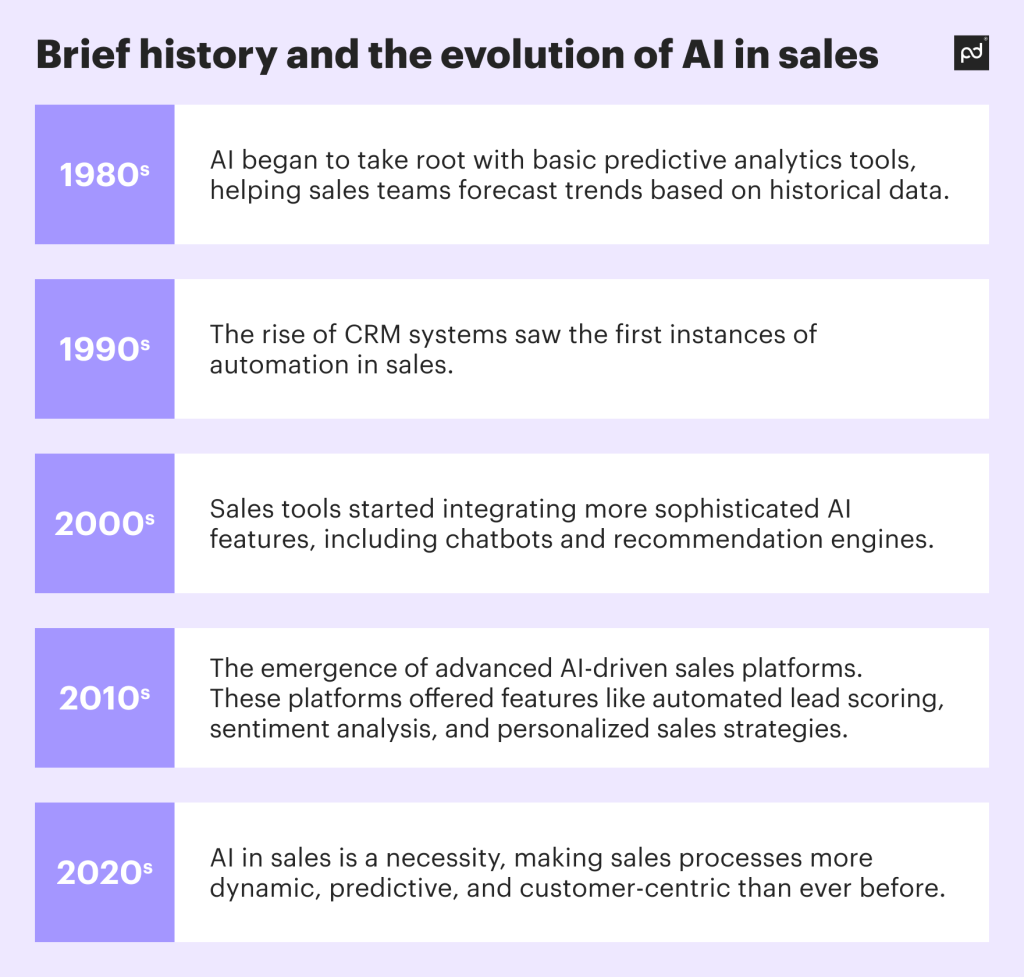
Brief history and the evolution of AI in sales
What are the benefits of using AI in sales
AI enables data analysis and personalization, helping sales teams optimize workflows. The result? Faster deal cycles, higher conversion rates, and more scalable revenue growth.
Below are the core benefits of using AI in sales, each with practical examples to demonstrate how AI creates real strategic value.
Enhanced customer insights
AI can analyze large datasets quickly and derive valuable insights into customer preferences, behaviors, and pain points.
Tech companies selling smart home devices can use AI to analyze customer reviews and feedback.
For example, an AI tool (like Brandwatch or Amplitude) identifies a trend: customers in colder regions appreciate the thermostats’ energy-saving features.
This insight helps companies tailor their marketing campaigns to highlight this feature in those specific regions.
As you can see, this deeper understanding enables you to craft strategies that yield higher sales with less effort.
Improved sales forecasting
AI algorithms can improve sales forecasting and predict revenue streams with greater accuracy than people.
AI examines additional inputs, such as historical data, current market trends, and external factors like economic indicators.
For example, fashion retailers can accurately predict the demand for winter coats.
By employing AI-powered analysis (like Salesken, Dealcode AI, or Freshsales), they can now immediately review past sales data, current fashion trends, and weather forecasts, which isn’t as feasible with just a manual approach.
Task automation
AI lets you automate routine tasks, from data entry to scheduling follow-ups.
The automation potential goes far beyond what is typically considered possible.
It also opens a hidden benefit. With AI, sales teams can automate the important tasks they neglected to allocate resources to due to their high labor intensity.
AI-powered CRM systems like Salesforce can automatically log details, adjust inventory, and set strategic follow-ups.
Better lead prioritization
AI-driven tools are much more advanced in lead scoring and ranking than typical sales reps.
These tools can access and use parameters far beyond the usual set you’ve used for manual scoring.
Online B2B platforms employing sales enablement software can score leads not just based on interaction metrics like page views or downloads.
AI can also analyze patterns in content engagement, time spent on specific product pages, and cross-referencing data — company growth indicators and recent industry news mentions.
You can use specialized tools like Akkio Augmented Lead Scoring, or even more universal LLM chatbot-based tools like ChatGPT or Claude.ai.
Using chatbots and virtual assistants
Chatbots and virtual assistants powered by AI are excellent in initial customer interactions, quite efficiently, and with record-breaking average response time.
For example, say you’re visiting a travel agency website and have a question about beach vacations. Chatbots provide instant package details, check availability, and book consultations with travel agents—all that the first-line support team had done in the past.
You can use specialized or customized AI-powered chatbots like Chatbot or Wonderchat, as well as a more general GPT-5.1 with API and predefined inputs.
Agile pricing policy
AI can analyze market trends, competitor pricing, and demand fluctuations to suggest dynamic pricing strategies.
Dynamic real-time pricing is very demanding and labor-intensive. Plus, you run the risk of setting the wrong price accidentally.
E-commerce platforms selling thousands of items can’t be supported by human-powered dynamic pricing.
Specialized AI-powered tools like Dynamic Pricing AI or Imprice can monitor dozens of competitors and hundreds of thousands of parameters and react immediately.
Improved sales coaching and training
Teams can use AI tools to review sales calls to identify areas of improvement and best practices.
It’s nearly impossible to manually review large batches of calls continuously.
But Colibri Sales Copilot and other similar AI software surely can.
Analyzing dozens of calls that an IT sales department makes daily, artificial intelligence identifies intricate trends — like newer reps that often struggle to explain particular features.
Sales managers then organize training sessions focused on these features, improving the teams’ pitches.
Read more: How to use document intelligence for real-time sales coaching
Personalization at scale
Manually crafting highly personalized messages for each customer segment is a huge challenge that requires tons of manual effort.
But with the power of AI, it’s much easier to do this at scale.
For example, Panda AI can instantly generate a personalized copy for each field of your sales proposal. All you need is to check and insert it.
The context for this copy can be borrowed from the block where the AI is added, your prompt, and the selected template.
For the cases that include crafting personalized messages, you can use ChatGPT or any other AI-powered conversational chatbots.
Developing an AI-powered sales strategy
To understand the transformative power of AI in sales, let’s cover how to develop an AI-powered sales strategy step-by-step.
We expanded each step with samples based on illustrative examples.
1. Identify current pain points in the sales process
This step helps you gain a clear understanding of areas that are unnecessarily draining time and resources.
For example, many sales teams spend several hours each day manually qualifying leads, which takes time away from engaging with high-value prospects.
Conducting an unbiased audit helps you understand what tasks are slowing down the sales process.
The goal is to document repetitive and time-consuming tasks that could be optimized or automated with AI.
- Start by conducting a thorough audit of your sales process
- Run workshops or surveys to understand your team members’ daily challenges
- Document repetitive or time-consuming tasks that could be streamlined with AI
- Consider outsourcing this audit to a sales consulting company, a good option to get new expertise and overcome your possibly biased vision
An AI-driven tool can:
- Automatically score and rank leads based on predefined criteria
- Predict lead conversion rates using historical data
- Reduce the time sales reps spend on manual qualification so they can focus on high-potential leads
Example: A technology company organized a series of focus group sessions. Each session included 8-10 sales reps from various regions and product lines. The sessions were facilitated by an external consultant to ensure unbiased feedback. They also used Wonderway.io AI-powered sales coaching software to optimize the sales process.
During these sessions, sales reps are asked about:
- Tasks that took up the most time in their daily routine
- Parts of the sales process they found redundant or unnecessary
- Challenges they faced in lead generation, qualification, and conversion
- Tools or resources they felt would help them be more efficient
Sales reps expressed that:
- They spent an average of 3 hours daily qualifying leads
- Almost 50% of the leads they engaged with weren’t a good fit for the company’s products
- Manual lead qualification often led to overlooking potential high-value clients
Potential revenue loss:
- If a sales rep’s average hourly wage was $30 and they spent 3 hours daily on lead qualification, the direct cost was $90 daily per rep
- With 50 sales reps, the total daily cost was $4,500
- Annually, this amounted to $1,125,000 spent on lead qualification alone
2. Set goals for AI adoption aligned with business objectives
Define specific, measurable outcomes you aim to achieve with AI.
Setting clear, measurable goals is crucial to drive focused AI adoption tied to business value.
The goals should be based on the pain points and opportunities identified in the sales process audit.
They must also align with overarching business objectives so that AI-driven improvements lead to tangible outcomes, such as increased revenue, lower costs, or improved customer retention.
For example, goals could be to reduce lead qualification time by 20%, increase sales team productivity by 15%, or boost customer lifetime value by 10% within a defined timeframe.
Having quantifiable metrics is key — rather than just aiming to “improve sales,” set targets like “reduce sales cycle by 5 days.”
An online retailer has noticed a plateau in sales despite increasing website traffic. They believed that enhancing the accuracy of their product recommendations could lead to higher conversion rates and, consequently, increased sales.
After analyzing its current product recommendation system, the company found that:
- The current accuracy of relevant product recommendations was at 60%
- Only 1 in 5 visitors added recommended products to their cart
- Customer surveys indicated a desire for more personalized shopping experiences.
The company’s broader business goal for the year was to increase online sales by 15%. Improving product recommendation accuracy is a key strategy to achieve this, as more accurate recommendations can lead to higher purchase rates.
Based on the initial assessment and alignment with the broader objective, the retailer set a specific goal: To improve product recommendation accuracy from 60% to 80% in the next quarter.
To understand the potential impact of this goal, they did some calculations:
- If 10,000 visitors are exposed to product recommendations daily, an improvement from 60% to 80% accuracy means 2,000 more visitors will receive relevant recommendations each day
- Assuming a conversion rate of 5% for relevant recommendations, this could lead to 100 additional sales daily or 3,000 additional sales monthly
3. Assess existing tech stack and infrastructure
Conducting a comprehensive audit of your current technology tools and platforms is crucial.
This is how you can clearly determine whether the current infrastructure supports integration or requires an upgrade.
- List all sales and marketing software, CRMs, analytics tools, data storage systems, etc.,
- Identify limitations — does your CRM offer AI capabilities? Can data systems handle real-time analytics?
- Get input from IT, sales, and other teams on their existing pain points
- Compare desired AI features against current tools’ abilities
- Look at data security protocols as well — AI relies on quality, well-organized data
For example, if you want AI for predictive lead scoring, assess if the existing CRM can provide this or needs an upgrade.
Assessing infrastructure helps budget for upgrades like newer CRMs, cloud data storage, and real-time analytics APIs.
If in-house expertise is lacking, engage external consultants to audit systems.
A real estate firm has been keen on using AI to optimize customer interactions and improve lead conversion rates. Before diving into AI adoption, they decided to assess their existing tech stack.
The IT department created a comprehensive list of all software, platforms, and tools currently in use. This includes their CRM, website backend, customer communication tools, and data storage solutions.
The sales and marketing teams listed the functionalities they expected from AI integration, such as predictive lead scoring, automated customer communication, and data analytics.
Comparing the current tech stack with the desired AI functionalities, the IT team identified that:
- The current CRM system couldn’t integrate AI plugins
- Their data storage solution wasn’t optimized for the real-time data processing required for some AI feature sets
To validate their findings and get a broader perspective, the company hired an external IT consultancy firm that:
- Confirmed the limitations of the current CRM
- Suggested potential CRM solutions in the market that are AI-compatible
- Recommended upgrades to the data storage system to support real-time analytics
Given the insights from the assessment and external consultation, the company’s management:
- Earmarked funds for upgrading to an AI-compatible CRM
- Allocated budget for enhancing data storage and processing capabilities
- Planned potential training sessions for staff to familiarize them with the new systems
4. Calculate ROI and budget for AI implementation
Conducting a detailed cost-benefit analysis is crucial in building the business case for AI investment and setting realistic expectations on ROI.
- Quantify all potential costs associated with AI adoption across software, hardware, integration, training, consultants, and staffing. Get help from finance teams or external experts to estimate expenses accurately.
- Then estimate benefits from increased efficiency, cost reductions, revenue gains, and other metrics driven by AI-driven process improvements.
- Compare costs versus benefits to determine ROI projections annually
ROI = (net benefits / total costs) x 100
Finally, decide between AI tools and set implementation budgets or timelines.
For example, AI could cut lead qualification costs by 20% through automation. It may take 12—18 months to break even, but project long-term gains.
A large restaurant chain was considering implementing an AI-driven inventory management system to optimize its supply chain and reduce food wastage. Below is a breakdown of how they calculated the ROI.
Annual food wastage costs: $500,000 (This includes spoiled ingredients, unsold dishes, and other food-related waste.)
Current inventory management system annual costs: $50,000
Total: $550,000
AI system setup and integration: $100,000 (one-time cost)
Annual AI system subscription: $70,000
Training for staff on the new system: $30,000 (one-time cost)
Total first-year costs with AI: $200,000
Total annual costs with AI (from second year): $70,000
By analyzing historical data and industry benchmarks, the company estimated that an AI-driven inventory management system could reduce food wastage costs by 15%.
Projected annual savings: 15% of $500,000 = $75,000
ROI calculation for the first year:
Total benefits (savings): $75,000
Total costs: $200,000
Net benefits (savings – costs): -$125,000
ROI = (-$125,000 / $200,000) x 100 = -62.5%
ROI calculation from the second year onwards:
Total benefits (savings): $75,000
Total costs: $70,000
Net benefits: $5,000
ROI = (net benefits / total Costs) x 100
ROI = ($5,000 / $70,000) x 100 = 7.14%
5. Research AI solutions tailored for key use cases
Now, it’s time to research the AI tools market for efficient solutions covering your needs.
This in-depth research helps create a shortlist of solutions likely to provide the best ROI.
- Explore tools tailored to your industry and processes
- Attend vendor demos to view options in action
- Ask detailed questions to assess capabilities vs. needs
- Read user reviews and case studies to learn real-world pros and cons
- Reach out to companies using shortlisted tools for candid feedback
- Evaluate ease of integration with existing tech stack based on audit findings
- Compare costs like licensing fees, setup, and training. For instance, if automating lead qualification is a priority, research AI-powered lead-scoring tools
- Assess features like lead rating, data analysis, and CRM integration
- Shortlist tools that align with use case requirements, have favorable reviews, and fit budget constraints.
A call center focusing on providing top-notch customer service recognized the potential of AI-driven voice analytics to enhance its operations. They set out to find the best tool for their needs.
A management team collaborated with floor supervisors to list specific requirements:
- Real-time voice sentiment analysis.
- Call transcription with keyword highlighting.
- Post-call analytics for training purposes.
The team conducted an online search to identify leading AI-driven voice analytics tools. They created an initial list of 10 potential solutions.
Over the next month, the team attended webinars hosted by these solution providers. They also request personalized demos to see each tool in action, focusing on their specific use cases.
The team also visited industry forums, read online reviews, and even reached out to other call centers using these tools.
They gather feedback on:
- The accuracy and reliability of voice analytics
- Ease of integration with existing call center software
- Quality of customer support provided by the tool vendor
For each tool, the team evaluated the cost of implementation and subscription against the potential benefits, such as reduced call handling time, improved customer satisfaction scores, and enhanced agent training.
Based on their extensive research, the company shortlisted three AI-driven voice analytics tools that best align with their needs and budget and received positive feedback from current users.
6. Test capabilities and ease of adoption
Before full-scale deployment, run controlled pilots using shortlisted AI tools with a small subset of users.
With preliminary real-world testing, you can validate the capabilities and ease of use.
- Start with a limited rollout, like 20—50 users, for 1—2 months
- Choose pilot participants from across roles, regions, and product lines to ensure diverse feedback
- Then develop quantifiable metrics to compare pre- and post-AI performance across factors such as sales productivity, lead conversion rates, and call resolution time
- Gather user feedback through surveys, focus groups, or interviews on satisfaction, challenges, and suggested improvements
- Analyze real results vs. defined goals. This data-driven approach helps determine if the tool delivers the expected value. It also uncovers potential pain points in UX or integration to address before company-wide implementation, such as specific blockers or complications in the workflows you need to automate or enhance with AI.
A finance company was eager to enhance its customer service and lead generation using an AI-driven chatbot.
Before fully integrating this technology, they conducted a pilot test.
Based on their previous research, the company selected a chatbot that promises real-time customer query handling, lead capture, and integration with their CRM.
The company decided to run the pilot for a month. They deployed the chatbot on two of their most visited web pages: “Home Loan Services” and “Credit Card Queries.”
A subset of the sales team, consisting of 10 representatives, was trained on the chatbot’s backend. They learned how to monitor conversations, intervene when necessary, and extract lead information.
During the test, the chatbot interacted with visitors, answering queries and capturing lead information. The sales reps monitored these interactions, occasionally stepping in for complex queries.
Two feedback forms were created:
- After each chatbot interaction, customers were prompted to rate their experience and provide comments
- At the end of the pilot, sales reps completed a detailed feedback form on the chatbot’s accuracy, ease of use, and impact on their sales activities
An analytics team assessed the chatbot’s performance by analyzing:
- The number of queries handled
- Lead conversion rate through the chatbot compared to traditional methods
- Average handling time for customer queries
- Customer satisfaction scores from the feedback form
The project team met with the sales reps to discuss their experiences. They looked at challenges, potential improvements, and the overall impact on their sales process.
Armed with quantitative data and qualitative feedback, management reviewed the pilot’s outcomes.
They assessed whether the chatbot met their expectations, its ROI potential, and any necessary modifications before a full-scale rollout.
7. Create training programs and change management plans for employees
Develop comprehensive training modules for each AI tool you plan to adopt.
Include both tool-specific and general modules.
- Tool-specific training covers functionality, workflows, data inputs, etc
- General training explains AI concepts, business applications, and benefits
Training should enable employees to master AI for tasks like data analysis, decision-making, and customer service.
Hands-on practical sessions are ideal over just presentations. If in-house expertise is lacking, engage external AI trainers or tool vendors.
Training helps employees gain confidence in using AI-powered systems through practice in a safe environment.
It also highlights how AI helps them be more productive and develop new skills.
Beyond training, address change management concerns transparently via town halls and 1-on-1 meetings.
Provide reassurance on job security and continuous support during transition. The goal is to equip employees to adopt AI, not just operate tools.
A car dealership decided to test an AI tool to optimize its lead generation process. Recognizing the importance of proper training and change management, they implement a structured approach to ensure smooth adoption.
After selecting the AI tool, they organized an orientation session. The session aims to introduce the sales team to the tool, highlighting its benefits and the rationale behind its adoption.
The company partnered with the AI tool’s vendor to design a training program. The vendor provided insights into the tool’s capabilities, best practices, and common challenges users might face.
Based on the vendor’s input and the dealership’s specific needs, a series of training modules were developed, covering:
- Basic tool navigation and interface understanding.
- Advanced features tailored to lead generation.
- Troubleshooting and common issues resolution.
The sales team attended hands-on workshops to use the tool in a controlled environment.
These sessions, facilitated by the vendor and in-house experts, allowed the team to practice and ask questions in real-time.
The management team also identified team members who might be resistant to the new tool.
They organized one-on-one sessions to address concerns, emphasizing the tool’s benefits and the dealership’s commitment to supporting its staff during the transition.
8. Develop ongoing metrics and benchmarks to track performance
Create a dashboard or reporting system to monitor AI’s impact.
- Start by identifying KPIs that indicate progress toward your defined goals, such as increased sales or higher productivity
- Work with teams and tool vendors to build custom dashboards for real-time tracking
- Integrate systems for making decisions, forming insights, or understanding a situation based on actual data
- Review metrics to spot trends, anomalies, and opportunities for improvement. For instance, if you track lead conversion rates over time, you can optimize your AI lead-scoring models.
- Look at sales forecast accuracy and refine algorithms.
This performance tracking process keeps AI outcomes aligned with business needs rather than operating in a silo, allowing tweaking tools for better precision. It also provides ongoing proof of ROI to justify investments.
A leading fashion retailer integrated an AI-driven demand forecasting tool to optimize inventory management and reduce stockouts. Recognizing the importance of tracking the tool’s performance, they devise a structured approach to monitor its impact.
The management team, in collaboration with the inventory and sales departments, listed down critical KPIs to measure the tool’s effectiveness:
- Accuracy of demand forecasts
- Reduction in stockout incidents
- Inventory turnover rate
- Cost savings from optimized inventory management
The IT department collaborated with the AI tool vendor to develop a real-time dashboard. This dashboard visually represented the KPIs, allowing easy monitoring and quick insights.
To ensure the dashboard reflects accurate data, integrations were set up between the AI tool, the inventory management system, and the sales database.
A recurring monthly review meeting was scheduled.
In these sessions:
- The dashboard metrics were presented and analyzed
- Any discrepancies or anomalies in the forecasts were discussed
- Feedback from the sales and inventory teams was gathered to understand ground-level challenges
- Strategies were devised to optimize the tool’s performance based on the insights
Based on the monthly reviews, management identified areas where the AI tool could be fine-tuned for better accuracy. They collaborated with the vendor for necessary updates or modifications.
Every quarter, performance metrics were compared against the initial goals set during the AI tool’s adoption. This helped determine whether the tool was on track to achieve the desired outcomes.
9. Continuously evaluate AI innovations and adapt as technology evolves
AI technology is evolving rapidly. To realize its full value, you must stay on top of the latest innovations and be ready to adapt to them quickly.
- Assign dedicated staff to track AI advancements through industry events, research publications, forums, etc.
- Visit industry conferences, subscribe to AI journals, and engage with AI communities. Be open to refining your strategy based on new insights
- Attend demos and proactively reach out to vendors of promising solutions
- Be ready to tweak strategies based on new solutions that align with goals. For example, if new NLP algorithms can improve automated lead classification accuracy, consider integrating them.
The aim is to build a sales tech stack that leverages cutting-edge AI advancements relevant to your needs. It is key to avoid stagnating with outdated tools when better solutions emerge.
A prominent logistics firm recognized the rapid pace at which AI technology is evolving. To ensure they remain at the forefront of innovation and harness the potential of new AI advancements, they implemented a proactive approach.
The company assigned a team member the specific role of AI research analyst. Their primary responsibility was to keep abreast of the latest AI developments relevant to the logistics industry.
Every month, the analyst attended at least two AI-related webinars. These webinars, often hosted by AI experts, tech companies, or industry associations, provided insights into the latest tools, techniques, and best practices.
Annually, the company sponsored their AI research analyst to attend major AI conferences. Here, they got the opportunity to witness live demonstrations, participate in workshops, and network with AI professionals.
The analyst subscribed to leading AI journals and magazines. These publications offered deep dives into recent AI research, case studies, and emerging trends.
The analyst became an active member of online AI forums and communities. These platforms allowed the analyst to engage in discussions, pose questions, and share the company’s experiences with AI implementation.
At the end of each month, the analyst organized a presentation for the team. They shared:
- Key takeaways from the webinars and conferences
- Highlights from the journals
- Discussions and insights from the AI communities
Challenges and considerations of using AI in sales
While AI offers a multitude of benefits in the sales domain, it’s essential to recognize and address the challenges and considerations associated with its implementation:
Data privacy concerns
With AI systems collecting and analyzing vast amounts of customer data, there’s a heightened concern about data privacy.
Implementation barriers
Adopting AI in sales isn’t just about purchasing a tool. It involves organizational alignment, training, and overcoming technical obstacles.
Possible issues with reliability and accuracy
AI systems, while powerful, can make mistakes. It’s crucial to review their outputs and not rely solely on their recommendations.
Continuous learning and adaptation required
AI models thrive on continuous data inputs. They require regular tweaking and updating to remain effective and relevant.
Finding the right balance between automation and human interaction
While automation can enhance efficiency, it’s essential to maintain human touchpoints in the sales process.
Addressing fear of job loss
The integration of AI often raises concerns about job displacement within sales teams.
Cybersecurity risks
With AI systems processing vast amounts of data, there’s an increased risk of cyberattacks and data breaches.
Ethical considerations
Ensuring AI systems operate without bias and with transparency is crucial to maintaining trust and ethical standards.
Key criteria for evaluating AI tools
When considering the adoption of an AI tool for sales, it’s also crucial to have a clear set of criteria to ensure the tool aligns with your business needs and values.
Here’s a table-style guide to help you evaluate potential AI solutions.
Each criterion contains three possible results, where the first one is always the most desired, the second one is acceptable but not preferred, and the third one is unacceptable (though not necessarily for all cases).
Some of the criteria might not affect your context. You may exclude them from your evaluation.
| Criteria | How to evaluate | Possible results |
|---|---|---|
| Integration with tech stack | Review the tool’s integration capabilities. Does it natively support your existing platforms? If customization is needed, consider the complexity and costs involved | — seamless integration — requires customization — incompatible |
| User interface quality | Test the tool with a diverse group of users. Gather feedback on ease of navigation, clarity of features, and overall user experience | — highly intuitive — moderately intuitive — not user-friendly |
| Accuracy of outputs | Run the tool through various scenarios and compare its predictions or outputs against known outcomes or benchmarks | — highly accurate — generally accurate — inconsistent accuracy |
| Learning and improvement | Investigate the tool’s learning methods. Does it adapt based on new data? How frequently is the model updated? | — continuous learning — periodic updates — static model |
| Training and support | Assess the vendor’s training materials, customer service responsiveness, and availability of resources to aid in tool adoption | — comprehensive support — limited support — no support |
| Model transparency | Determine if you can access and understand the model’s decision-making process. Is the logic behind predictions clear and explainable? | — fully transparent — partially transparent — black box |
| Ethical AI practices | Review the tool’s approach to avoiding biases, ensuring fairness, and other ethical considerations. Does the vendor have a clear stance on ethical AI? | — comprehensive ethical guidelines — basic guidelines — no guidelines |
| Data security and privacy | Investigate the tool’s data handling practices, encryption standards, and access controls. Ensure compliance with relevant data protection regulations | — robust security measures — basic security — lacks adequate security |
| Costs | Break down all potential costs, including initial setup, deployment, training, and ongoing fees. Compare against your budget and expected ROI | — one-time fee — subscription-based — variable costs |
| Future evolution | Engage with the vendor to understand their vision for the tool. Are there plans for new features or improvements based on emerging AI trends? | — clear roadmap — vague plans — no future plans |
The future of AI-driven sales
As we look to the horizon, it’s evident that AI will surely redefine roles and introduce new paradigms. Here’s a glimpse into the potential future of AI-driven sales:
Predictive sales processes
With the continuous refinement of AI algorithms, sales processes will become increasingly predictive.
AI will analyze vast datasets to forecast customer needs even before they arise.
This proactive approach will enable businesses to offer solutions tailored to individual customer requirements, often before the customer has even identified a need.
Enhanced virtual selling
Virtual assistants, powered by AI, will play a more significant role in sales, handling everything from initial inquiries to closing deals.
These AI-driven entities will engage customers in natural language, providing information, answering queries, and negotiating terms.
Role evolution
With AI handling many of the routine and data-driven tasks, the role of sales professionals will evolve.
They will focus more on building deep customer relationships, understanding nuanced needs, and offering strategic solutions.
Ethical selling and transparency
With AI’s capability to analyze vast amounts of personal data, there will be an increased emphasis on ethical selling.
Companies must ensure they use data responsibly, maintaining transparency with customers about how their data is used.
Integration of augmented reality (AR) and virtual reality (VR)
AI, combined with AR and VR, will offer immersive sales experiences.
Customers can experience products or services in a virtual space, aiding their purchase decisions.
As you can see, the future of AI-driven sales promises a blend of technology and human interaction, where AI tools handle both data-driven decision-making and rote tasks and routines, and humans focus on supervising and correcting the AI efforts, as well as on enriching them with personal touch.
This synergy will drive sales to new heights, offering unparalleled customer experiences and business growth.
Wrapping up
AI tools can analyze vast amounts of data and make smart decisions, draw patterns, and make quite accurate predictions.
But the human element, understanding, empathy, and ethical judgment, is irreplaceable
As businesses integrate AI into their sales processes, they must ensure these tools are used responsibly.
Transparency in how customer data is used, ensuring fairness in AI-driven decisions, and avoiding biases are all highly important.
The future of AI-driven sales is bright and filled with opportunities and innovations.
But as we stride forward, let’s do so with a commitment to ethical adoption and a focus on the invaluable human-AI collaboration.
Automate your sales process with PandaDoc
PandaDoc helps sales teams close deals faster with streamlined proposals, quotes, and contracts, powered by automation and built-in AI features.
- Proposals and contracts: Create polished, on-brand docs fast using templates and a content library
- Interactive quotes: Add pricing tables that clients can customize
- CRM-connected workflows: Auto-generate docs from CRM platforms, including Salesforce, HubSpot, and Pipedrive. Track opens, comments, and signatures.
- eSignatures: Built-in, legally binding, and trackable
- Use the AI Assistant to track recipient engagement and analytics (e.g., whether the proposal was opened, viewed, time spent on each page, etc.).
- Use AI email suggestions to instantly draft personalized, contextual email copy when sending a document for signature
Try it now by starting a 14-day free trial or requesting a free demo.
Frequently asked questions
-
AI plays a key role in the sales process by automating tasks, analyzing customer data, and improving-decision making.
Using AI in your sales strategy allows teams to identify qualified leads, personalize outreach, forecast revenue, and optimize pricing.
AI-powered tools can also help to enhance customer engagement through chatbots, analysis, and predictive insights.
-
AI will not fully replace sales reps, but the use of technology will transform their roles. AI tools automate repetitive tasks like data entry and lead scoring, allowing reps to focus on building relationships and closing deals.
Human skills like empathy, trust-building, and negotiations will always be essential in the sales process. AI is a complement not a replacement.
Disclaimer
PandaDoc is not a law firm, or a substitute for an attorney or law firm. This page is not intended to and does not provide legal advice. Should you have legal questions on the validity of e-signatures or digital signatures and the enforceability thereof, please consult with an attorney or law firm. Use of PandaDocs services are governed by our Terms of Use and Privacy Policy.