

Businesses put a lot of time into compiling and managing contracts, but storing them properly is just as critical.
Modern platforms support AI-powered data extraction, obligation and milestone tracking, automated renewals, and deep integrations with CRM, ERP, and finance systems.
This gives your teams real visibility into their agreements across the entire business.
Keeping contracts in an accessible, secure, and centralized location helps organizations reduce risk, stay compliant, and make better decisions.
A contract repository system can provide an efficient solution to this problem. Let’s find out more.
In this article, we’ll explain what contract repositories are, the importance of managing them, their benefits, and how to set one up.
Key takeaways:
- Modern contract repositories keep contracts secure and available through centralized, digital spaces.
- Minimize mistakes, time-wasting, and accuracy issues by utilizing a contract repository.
- Guarantee security and compliance by centralizing your contracts.
- Enjoy all the benefits of a contract repository as part of a comprehensive contract management system.
Quick contract generation with PandaDoc
Customize, negotiate, and eSign complex contracts.
What is a repository?
A repository is simply a place for storing something.
Traditionally, repositories have been used for storing all manner of things: documents, photos, books, and more.
Today, the term usually applies to a digital repository. A place for storing important files and documents.
Data repositories use the cloud to provide safe spaces where files can be accessed from anywhere.
There are three forms of data repositories. Let’s look at each in more detail.
A data warehouse
Certain companies deal with large volumes of data. For these organizations, simple cloud storage isn’t enough.
They need a space where large volumes of data can be kept, analyzed, and used. A data warehouse is designed for structured data.
This involves data from various areas across an organization.
A data mart
Unlike a data warehouse, a data mart is much more specific. A data warehouse is designed to work for an entire organization.
A data mart supplies data to specific departments or users within an organization. The HR department, for example, might use a data mart for payroll software.
A data lake
Both data warehouses and data marts deal with structured data. A data lake contains large amounts of raw, unstructured data.
Data lakes can serve many purposes. One example is to provide raw data to AI-powered machine learning tools.
What is a contract repository?
As you might expect, a contract management repository is a place for storing contracts. As with all repositories, contract repositories haven’t always been digital.
Traditionally, they were physical locations dedicated to the storage of paper contracts. As you can imagine, in the case of a large enterprise, considerable storage space might be needed.
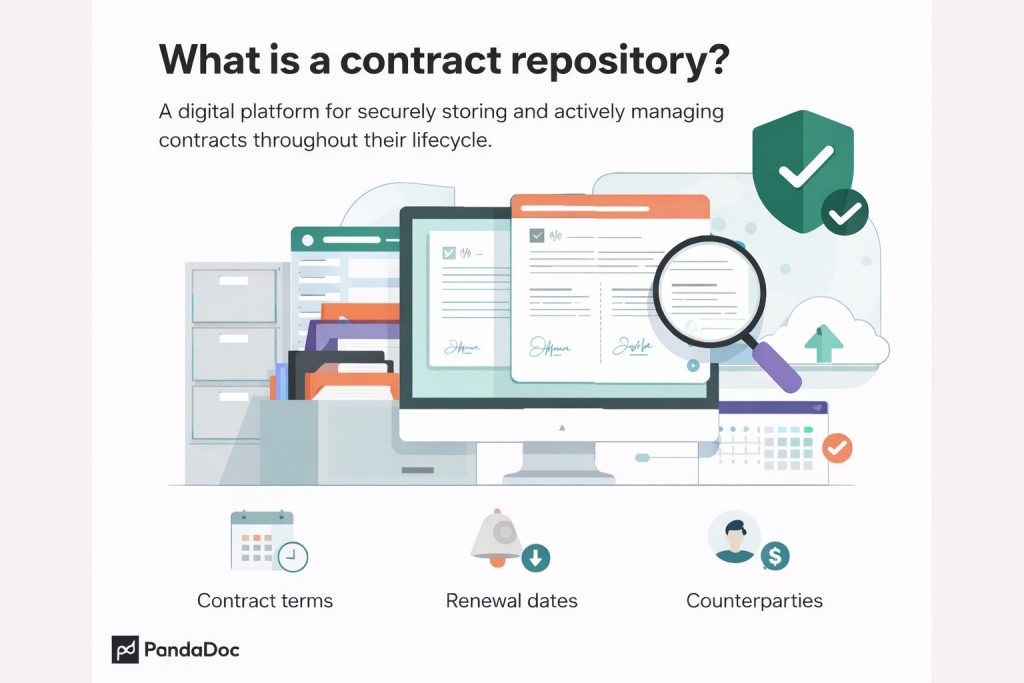
Today a contract repository is a centralized, digital space for keeping your contracts secure and available. A contract repository is typically part of a wider package of contract management software, and it’s designed to do more than store files.
Unlike basic document storage tools, a contract repository is built specifically to manage contract data, capturing and organizing key information like contract terms, renewal and expiration dates, obligations, values, and counterparties.
This structured data allows you to search, report on, and actively manage contracts throughout their lifecycle, instead of simply archiving them.
It usually consists of scans of physical documents, PDFs, and other files. Like any digital repository, contracts can be accessed from anywhere.
As long as a user is authorized, they can access files from their PC, mobile device, or tablet.
What are the benefits of a contract repository?
A contract repository has several significant advantages, particularly for organizations dealing with a high volume of contracts.
Some key benefits include:
Improved organization
With all contracts stored in one centralized location, it’s easier to locate documents quickly and avoid duplication.
Always up to date
A simple mistake, but one made all too often, is businesses using the wrong version of a contract. Let’s consider two scenarios in which you are negotiating a contract with a client.
In the first scenario, you don’t have a contract repository. Different versions of the same contract are kept unorganized in filing cabinets. When it’s time for parties to sign the contract, you pick an outdated version. The document that was signed did not contain the necessary provisions, so you didn’t achieve the agreement you wanted. This was all due to poor contract storage management.
Now let’s imagine a scenario where you do have a contract repository. You can easily access the most up-to-date version of a document when needed. There’s no risk of accidentally choosing the wrong document. The correct version of the document is signed, and all parties are happy.
Time saved
Perhaps the biggest advantage of maintaining a contract repository is the amount of time saved.
Without a dedicated and organized space for contracts, it’s much harder to find the documents you need.
Even if you find a contract, you can’t be sure it’s the latest version. You’ll waste even more time correcting mistakes if you’ve used or worked on an out-of-date version. This is time that could have been spent on more productive tasks.
A smart contract repository ensures that agreements are kept in a centralized space. With the help of meta tags, you easily find the document you’re looking for.
Enhanced accessibility
Digital repositories allow authorized users to access contracts from anywhere.
Greater security
It’s vital that you have a secure contract repository. Cybersecurity risks are constantly increasing, as hackers find new ways to breach systems. A breach of security could lead to the loss of important documents.
If you find that customer data is leaked, you’ll damage relations and reputation.
Luckily, the best contract repositories come with advanced security features. This includes password protection, firewalls, and the ability to control access to documents.
Better compliance
Metadata and search features make it easier to monitor key dates, terms, and obligations.
Reduced risk
By maintaining version control, repositories help prevent errors such as acting on outdated agreements or missing critical obligations.
Data insights
The metadata stored with contracts allows for analysis, providing insights into trends and opportunities within your contracts.
Automated contract data extraction using AI
AI Data Extraction automatically extracts and organizes critical contract data (dates, terms, parties, values, etc.) from documents. With PandaDoc, for example, users can review, validate, and accept AI suggestions before the data becomes searchable, filterable, and reportable.
This is helpful because it gets rid of manual data entry, decreases errors, and makes searching and reporting much easier.
Renewal and expiration alerts to prevent missed deadlines
Automated alerts notify teams of upcoming renewals and expirations, helping prevent missed deadlines, unwanted auto-renewals, and last-minute scrambles.
Obligation tracking to reduce compliance risk
Obligation tracking makes it so that contractual commitments are visible and monitored, which helps your team stay compliant and avoid penalties or disputes.
Contract analytics for vendor, spend, and risk visibility
Built-in analytics provide insights into vendor relationships, contract spend, and potential risks. This makes for better decision-making and negotiation strategies.
What does a contract repository contain?
In addition to all of the information captured within the contract, the content stored in a repository will contain metadata.
This is important as it provides contextual information about the contract.
Metadata makes it easier to identify information about the contracts within the repository.
It can also be vital when producing analytical data about an enterprise’s contracts.
Forms of metadata contained in a repository might include:
- The form of contract.
- The condition of the contract (active, inactive, terminated).
- The department that a contract relates to.
- Significant dates.
- List of signatories.
- The ownership of a contract.
- Additional contextual information.
How does a contract repository integrate with your current systems?
A contract repository system is a centralized digital platform for securely storing and managing contracts, operating as a seamless extension of your existing workflows.
The right system should integrate with your CRM, document management tools, and other business applications to keep contract processes smooth and connected.
PandaDoc makes this easy by integrating with CRMs so you can generate, store, and manage contracts directly within the platforms you already use.
Features like metadata tagging, version control, and role-based access ensure secure, organized, and efficient contract management—all without disrupting your workflow.
The importance of contract repository management
Contract repository management is very important for a number of reasons.
The process of managing contracts can be extremely involved. This is especially the case with larger organizations.
Each stage of a contract, from initial negotiation through to signing, often has a dedicated team. Each team needs the right information to make informed decisions.
This requires instant access to older versions of contracts, something that is only possible with a repository.
Below are some disadvantages of not having a repository.
- Time wasting – It will take longer to find the files that you need.
- Inaccurate documents – It’s all too easy to select the wrong version of a contract.
- Failure to act on forgotten clauses – Without regular reference to the contract, some payments generated by clauses within it may be missed. This leads to missing financial transactions and incorrect reporting.
- Mistakes – For instance, you may end up renewing unwanted agreements.
In the end, it’s more trouble not having a contract repository.
Although setting one up may seem a hassle, you’ll thank yourself in the long run.
See also
Contract generation: Crafting custom agreements for business success
How do you set up a contract repository?
Setting up a contract repository begins by finding the right solution.
Many different providers are available, and you also have a choice of a pure repository and broader contract software.
It’s vital you choose a provider with a strong reputation.
This will give you the best chance of selecting reliable software that is user-friendly and has the features you need.
Having identified potential suppliers, there are two main routes that you can go down.
Repository only solution
For many businesses, all that might be needed is a pure repository for your contracts.
This is filled with features to make contract access and storage easier and more secure.
We’ll explore the bells and whistles these give access to in the next section.
Repository software as part of a wider package
You also have the option of choosing a solution that contains a repository as part of a wider contract management package.
If you select this option, you’ll get all the standard features of a repository.
In addition to these, the best contract management software helps you to automate the creation of contracts.
It will provide templates, workflows, eSignature facilities, and more.
The route that you choose will depend on the needs of your organization and the available budget.
What to evaluate when choosing a contract repository
Remember that not all contract repositories will have the same capabilities. When you’re evaluating your options, look for features that support your long-term contract management.
Here are some stand-out features to consider:
-
AI data extraction accuracy: Look for a platform that can reliably extract key contract data such as dates, terms, values, and obligations with little manual correction. Accuracy matters, especially at scale.
-
Renewal and obligation automation: Whatever repository you choose, it should automatically track renewals, expirations, and contractual obligations, with configurable alerts. This will help you stay compliant and avoid missed deadlines.
-
Reporting and contract analytics: If you choose a repository with built-in reporting and analytics, you’ll have an easier time analyzing vendor relationships, contract spend, risk exposure, and performance trends across your contract portfolio.
-
CRM and ERP integrations: Native integrations with CRM, ERP, and finance systems will allow your contract data to flow seamlessly across your business. This helps with sales, procurement, and financial workflows.
- Security, audit trails, and compliance certifications: Make sure your repository has strong security controls, detailed audit logs, and recognized compliance certifications. These are essential for protecting sensitive contract data and meeting regulatory requirements.
See also
Contract extensions: What they are, when to use them, and how
Contract repository vs basic document storage
General doc storage tools can hold contract files, but they don’t have the contract intelligence and lifecycle management that contract repositories have. A dedicated contract repository will be better for managing contract data, obligations, and risk.
Contract repository vs Google Drive
Google Drive pros:
Google Drive is great for uploading, sharing, and syncing contract files across devices, and it does have basic version history and permission controls.
Where it falls short:
Drive doesn’t extract contract metadata (like renewal dates, terms, or obligations), automate alerts, or provide contract-specific reporting.
This means there’s no built-in obligation tracking, standardized clause search, or contract lifecycle visibility. All of these are really useful features for managing your contracts.
Contract repository vs SharePoint
SharePoint pros:
SharePoint is better than using basic cloud storage when it comes to organizing files and managing access. It also offers version control and permissions that can be used across your teams.
Where it falls short:
SharePoint lacks the type of contract automation that powers renewal reminders and obligation tracking. If you want analytics and contract-centric workflows, it would require extensive customization or a third-party tool. A contract repository doesn’t need all that extra setup, since it’s built into the tool itself.
Contract repository vs Docusign storage
Docusign storage pros:
Docusign can store executed agreements and can automatically route signed contracts into a centralized ligation, if it’s integrated with storage.
Where it falls short:
Docusign’s default storage is more focused on signed documents instead of managing contract data across the entire lifecycle. It requires a proper repository or CLM layer to provide advanced analytics, automated obligation management, etc.
With a dedicated contract repository, data will be captured before and after signature. Plus, it can be integrated with eSignature tools.
Crucial contract repository features to guarantee effectiveness
As mentioned, a contract repository gives a user access to a plethora of tools. These help you in a number of ways.
This ranges from managing control of contracts and access to them to locating documents. Every effective contract repository should contain the following features:
Extraction tools
On a base level, every contract repository should be able to retrieve metadata.
But beyond this, the tool should be able to extract more in-depth information. This includes information relating to clauses, commitments, and terms.
A document viewer
Your document repository should support native document viewing. In other words, you shouldn’t need to switch to a separate program to view files.
Advanced search
By inputting a few simple queries, you should be able to easily find specific areas of contracts. Advanced search should allow you to search using any of the following:
- Keywords
- Date/time
- Vendor
- Location
Data analysis
Your repository should be able to provide insights relating to data within your contracts. These insights might take the form of charts, reports, and tables.
Control permissions
Contracts can often contain sensitive information. For that reason, you won’t want everyone accessing agreements.
Your chosen solution should allow you to control permissions. This ensures that only those with the right level of clearance can view contracts.
Integrate with other programs
It’s useful for your contract repository to integrate with other programs. This allows you to bolster your contracts with cross-program data.
The contract repository solution
Lack of a centralized space for contracts can cause all sorts of problems. You’re restricted in your ability to finalize deals quickly and satisfactorily.
Customers are dissatisfied due to delays. There are potential security risks due to uncontrolled access and a lack of security.
Thankfully, there’s a solution! PandaDoc’s contract management system provides all the benefits of a contract repository.
It can refine your business processes from contract creation to payment.
Not only that, but it can organize all your contracts with multiple addenda and modifications.
Why not begin the process of streamlining your contract management? Request a demo today and see how PandaDoc can help you.