Contracts are foundational to how most businesses operate. Agreed-upon terms and signed deals make it possible for companies to secure products, offer services, hire employees, and much more.
However, every contract also introduces some measure of risk. Poorly defined or informal agreements, unclear responsibilities, and unrealistic deadlines can lead to financial loss and operational disruption across a company. As organizations scale and the number of agreements in place expands, contract risk becomes harder to track and easier to overlook.
Contract risk management provides a structured approach to identify potential issues, evaluate their impact, and reduce exposure before agreements are enforced. Proper risk management allows teams to spot and resolve issues long before they occur.
In this guide, we’ll break down concepts around contract risk, why it matters, and how to manage those factors without slowing down deals.
What is contract risk?
Contract risk is the possibility that a contract will expose an organization to loss, disruption, or liability. Usually, this risk stems from the language used in an agreement, the obligation it creates, and how well those obligations are tracked over time.
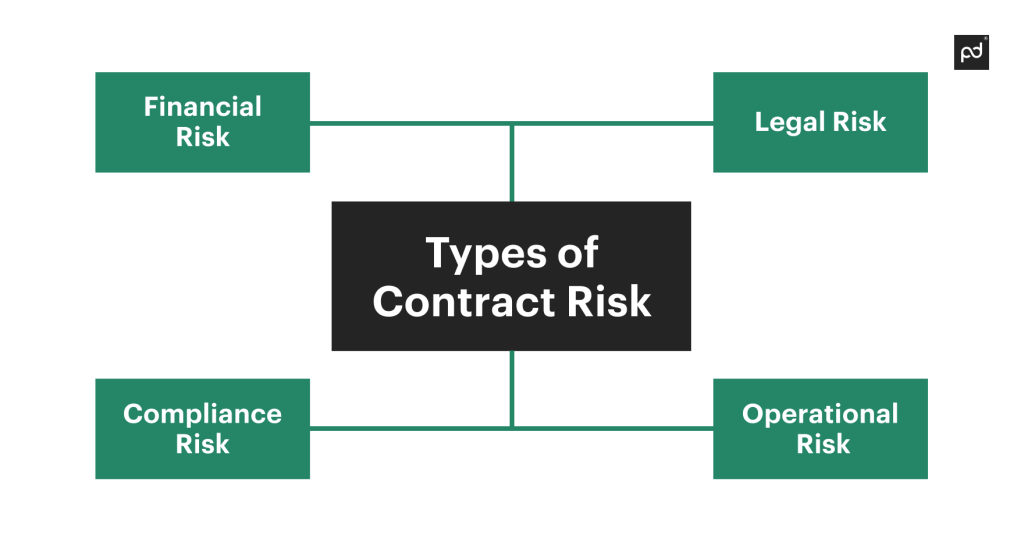
Most contract risk falls into five basic categories:
-
Legal risk includes unenforceable terms, regulatory noncompliance, or disputes over how contract language should be interpreted.
-
Financial risk involves unexpected costs, missed payments, penalties, or revenue loss tied to contract terms.
-
Operational risk occurs when unclear responsibilities, timelines, or service levels disrupt day-to-day business operations.
-
Security risks happen when contracts fail to adequately address how sensitive data should be stored, accessed, or protected.
- Reputational risks cover potential harm to a company’s brand resulting from disputes, compliance failures, and publicized contract issues.
If you’re looking for a deep dive into common contract management risks, check out this article.
For now, keep in mind that contract risk doesn’t require bad intent or negligence, nor is it limited to complex agreements. Often, this risk stems from ambiguity or inconsistent contract management practices.
The outcome is an operational disruption and potential legal or financial consequences for both parties.
Risk vs threat
When dealing with contracts, risk and threats are commonly confused. These are best defined through better specificity:
-
Contract risk is the potential for loss or disruption arising from a contract. For example, a service contract that lacks clear service-level commitments carries significant operational risk, as undefined terms can impose heavy obligations on the company.
- A contract threat is a specific action, failure, or event that causes a risk to materialize. If a vendor partner consistently misses delivery timelines or performance expectations, their operating practices become a threat to the contracting brand and may put them in violation of the agreed-upon terms.
Although different, threats and risks often go hand-in-hand.
Risks are inherent in contracting, as companies pay to acquire goods or services that support their business. Vendors and partners are expected to shoulder some risks and potential penalties when accepting the contracted terms.
Once risks are established by the terms of the contract, both parties need to prepare for and defend against potential threats that can place them out of compliance. Some threat defense is simple — such as hiring enough employees to comply with any uptime or availability requirements — while defense against something like a data breach or regulatory changes post-contract may be more involved.
What is contract risk management?
Contract risk management is the process of identifying, assessing, and mitigating risks associated with contracts throughout their lifecycle.
During the drafting and negotiation stages, compliance teams and risk managers can combine policy, process, and oversight to protect the company from overextending itself. Often, this involves insisting on closed-ended terms, guarantees, and hard caps for services rendered, such as an uptime target or established support hours. Companies can also refuse to accept certain risks or offload any risks beyond their control.
Example: Contracts at Acme Inc. carry language that absolves the company of responsibility for delivery timelines.
However, Acme relies on commercial carriers to ship its products. The company has no control over the carrier’s shipments, and the process is entirely out of their hands. When reviewing contracts, the company must be careful to protect itself from the contractual risks involved with delivery.
In Acme’s case, committing to specific delivery timelines would threaten their ability to stay compliant.
During execution, managing risk means ensuring the company has the resources it needs (time, people, product, etc.) to remain compliant with contractual agreements. The exact strategy will change on an as-needed basis if unforeseen threats materialize.
In most cases, experienced contract teams will do all they can to offset any unmanageable risks by using approved legal clauses or identifying risk-prone clause issues during negotiation and redlining.
Why it matters
Effective contract risk management reduces the likelihood that contracts will become a source of conflict or loss between business partners.
If risks can be identified and managed throughout the contract lifecycle, organizations can reach consensus and prevent issues before they escalate into full-blown disputes. When that happens, both companies risk losing profits or engaging in protracted litigation that can take years to resolve.
When managed correctly, companies can reduce exposure and maintain control of the risks they take. As contracts become more numerous and complex, ensuring these issues are handled in a quantifiable, trackable way can be the difference between failure and success.
Contract risk management tools
Even though the risk management process evolves as contracts move through their lifecycle, potential threats and liability issues can materialize at any time. While teams might believe they’re committing to manageable contract terms, a mix of bad luck and poor business decisions can easily push a company out of compliance.
To avoid that, teams need to keep an eye on potential risks and threats at all times. Tools and solutions can help brands standardize these workflows, ensure contracts remain consistent, and maintain accountability throughout the contracting process.
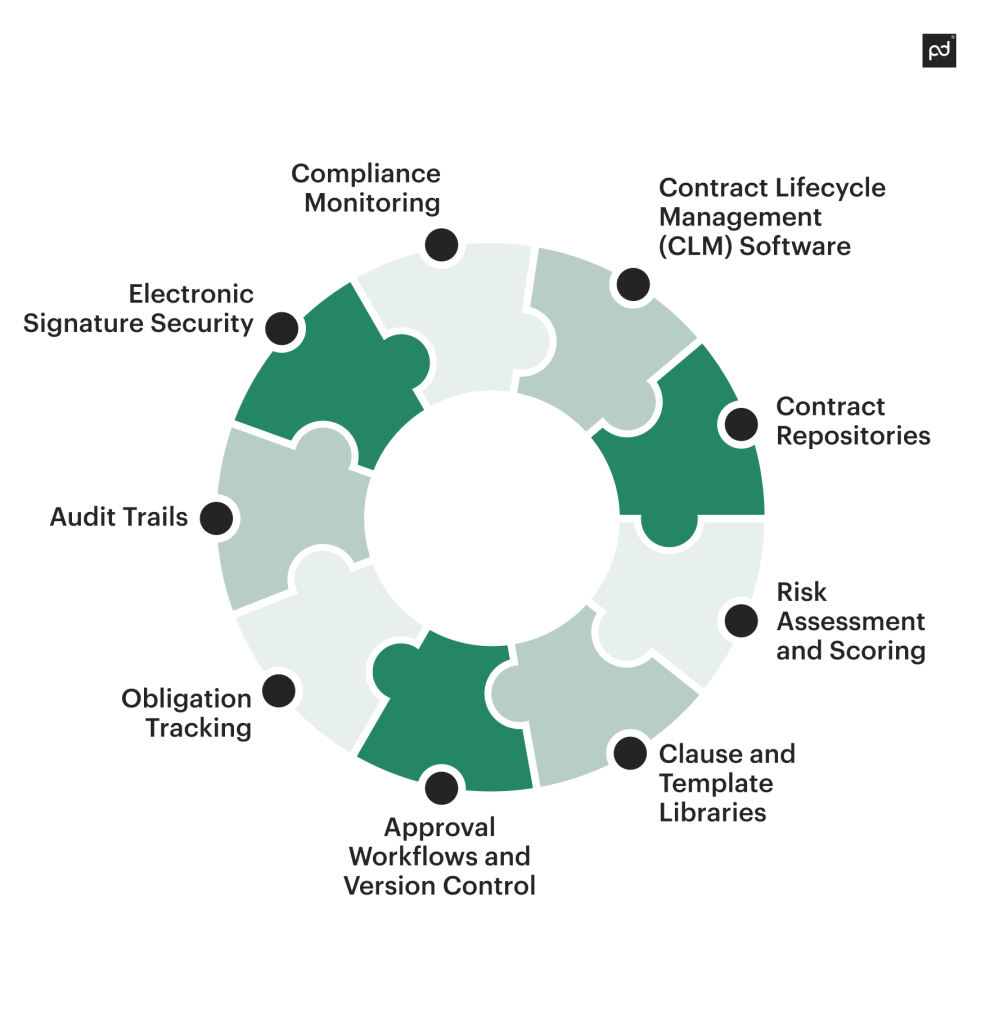
Here’s a closer look at common contract risk management tools used by high-performing teams:
-
Contract lifecycle management (CLM) software. CLM software supports contracts at every stage of the lifecycle, from drafting through execution, renewal, and termination. By centralizing all aspects of the document creation process (drafting, review, approval, tracking, etc.), CLM tools help reduce inconsistencies and limit risk by creating a standardized process where steps can’t be skipped or overlooked.
-
Contract repositories. A repository keeps all contracts stored in a centralized location for easy access. This effectively becomes a single source of truth, improving visibility into contracts and their associated terms. Teams can monitor renewals, review obligations, and manage deadlines more easily because everything is in one place.
-
Risk assessment and scoring. When weighing contract obligations against predefined factors such as financial exposure or regulatory impact, risk-assessment scoring can help teams set approval thresholds for contracts and focus on higher-risk agreements.
-
Clause and template libraries. Typically, clause libraries and document templates are built to store pre-approved contract language for common terms and risk scenarios. This language can be created, reviewed, and approved by teams like legal and finance, then locked in place so that sales and service reps can’t change the terms, enabling scalability while mitigating risk.
-
Approval workflows and version control. Approval workflows make sure that contacts are reviewed by appropriate stakeholders while version control can clear up confusion about how a contract evolved and what changes were made. Both functions reduce the risk of unauthorized edits and conflicting versions of a document.
-
Obligation tracking. Tools that can track commitments and responsibilities like deliverables, service levels, reporting requirements or deadlines can be useful for tracking whether a contract has been fully executed and that all obligations are met.
-
Audit trails. Trackable records of contract activity, including edits, approvals, and electronic signatures support regulatory compliance, internal audits, and dispute resolution by providing clear evidence of how and when contracts were modified or executed.
-
Electronic signature security. Security around e-signatures protects contracts during execution by verifying signer identity and preserving document integrity. Secure e-signing tools reduce the risk of fraud, tampering, or disputes over whether an agreement was properly authorized.
-
Compliance monitoring. In niche industries, compliance monitoring tools help to verify that contracts align with applicable laws, regulations, and internal policies. These tools are particularly valuable when regulations change after a contract is signed and can help teams identify agreements that may require updates.
Often, many of these software tools and features can be consolidated into one platform. By itself, PandaDoc can offer CLM management, clause libraries, version control, audit trails, and much more. This allows companies to consolidate their entire document process under one roof so that contracts and agreements are much easier to manage.
More importantly, PandaDoc can integrate with other solutions in your tech stack. While we don’t offer obligation monitoring or compliance tracking, it’s possible to connect these features to your document process using our API or a Zapier integration. That way, every system integrates into a seamless workflow that reduces risk and lowers potential exposure.
How to mitigate contract risk
While risk is an inherent part of every contract, teams can reduce the potential for exposure through standardization and tracking.
Because the risks associated with a contract persist through the duration of the deal, repeatable processes and workflows offer a way for brands to actively monitor obligations and take proactive steps to remain compliant with existing terms.
A structured approach to contract mitigation helps teams apply the same standards across every contract, regardless of value or complexity. In doing so, teams can manage risks more effectively and expand the obligations that the brand can undertake.
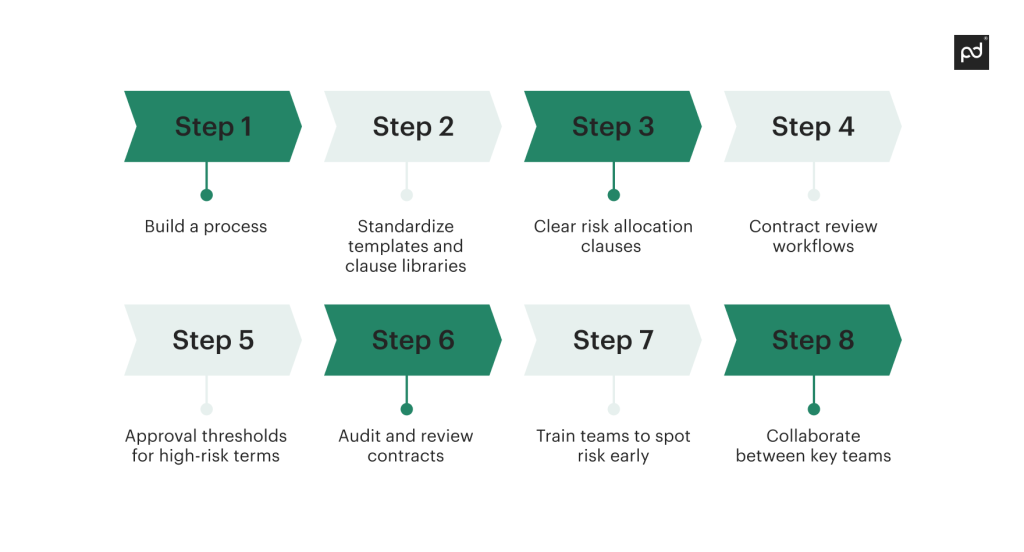
1. Build a process
As companies take on more contracts, building a structured risk management process becomes essential. Without clear procedures, contracts can be handled differently, leading to uneven exposure potential and gaps in oversight.
A strong document process should establish how contracts move through the lifecycle and specify who is responsible at each stage. Teams will need to create criteria that must be met before deals move forward. Automation within the document workflow can make sure that all steps are consistently applied. With the appropriate stopgaps and accountability measures in place, risks can be identified and addressed consistently across all teams.
Note that this process should extend beyond contract execution. Outstanding obligations generated by the contract need to be tracked so that performance and compliance issues can be addressed before they lead to disputes.
2. Standardize templates and clause libraries
Templates and clause libraries play a key role in mitigating contract risk by keeping terms consistent across all agreements, regardless of who creates the document or handles negotiations.
Approved, custom templates should reflect current policies and risk standards while clause libraries store vetted language for frequently used provisions. These provisions can define the overall structure of the agreement while also providing some maneuverability (within approved margins) that reps can use to close deals without overcommitting company resources.
For most companies, this level of standardization goes hand in hand with scalability. By leveraging templates and approved clauses, a company can scale contracting activity without increasing exposure. Teams move faster through negotiations while maintaining control over risk-sensitive clauses.
3. Clarify risk allocation clauses
Risk allocation clauses define how responsibility is shared between contracting parties when issues arise. They’re critical for managing exposure and usually deal with how losses, liabilities, and responsibilities are handled under a contract.
Common risk allocation clauses address areas such as indemnification, limitations of liability, or service-level commitments. When clearly written and consistently applied, parties can better understand what risks they’re accepting and the scope of their own liabilities under the agreement. If this language is inconsistent, terms become vague, leading to disagreements, misinterpretations, and disputes.
When trying to mitigate risk, take time to clarify risk allocation in these clauses so that all parties have a clear understanding of the risks and obligations associated with all contracted terms.
4. Contract review workflows
A formal review process is critical for managing risk effectively. Without these workflows, contracts can bypass reviews or rely on informal approvals, ultimately increasing the likelihood that risks go unnoticed before an agreement is signed.
A defined workflow should outline review stages, assign responsibility, and set expectations for turnaround times. Clarity throughout this process can reduce delays and prevent deals from moving forward without proper oversight. An established review flow also makes it easier for compliance teams to track contract progress and accountability in the deal flow.
When building this flow, keep in mind that it needs to be flexible enough to accommodate different contract types and levels of risk. Low-cost contracts may not receive the same scrutiny or be allowed the same level of flexibility as more valuable agreements, but the system needs to be able to handle any deal that falls into the pipeline.
5. Approval thresholds for high-risk terms
Approval workflows allow teams to create clear rules when a contract exceeds standard thresholds or limitations. Thresholds can be based on contract value, liability caps, indemnification terms, data handling requirements, or any number of risk-prone areas of operation.
In most cases, this is an automated process. If a proposal exceeds a specific cost, or if a stakeholder requests a change to terms that exceeds pre-determined rules, the contract is flagged as a potential high-risk document and routed for additional review by specific teams or individuals.
By putting these thresholds in place, brands can effectively align risk decisions with authority and expertise. High-risk contracts receive specialized attention as required, while lower-risk agreements aren’t delayed by unnecessary review processes.
6. Audit and review contracts
Risks can change as agreements age or as external conditions shift. Because this can open a company up to unexpected threats and exposure, contract audits and post-close reviews are an essential part of risk management.
Teams should review contracts periodically to make sure that obligations are being met and that terms remain both enforceable and compliant. Audits may reveal missed deadlines, unfulfilled service terms, or provisions that no longer reflect current regulations.
By identifying these gaps, auditors can assist with accountability and flag issues before they spiral out of control. On top of that, reviews give leadership an opportunity to assess how well contract management processes are working and where improvements are needed. Over time, reviews can strengthen risk management and improve contract oversight.
7. Train teams to spot risk early
While it might seem easier to consolidate risk management into a single team or individual, this process is most effective when spread across multiple departments and users. Training employees to recognize potential risks early helps to catch issues before they become embedded in agreements.
While training will vary between teams, focusing on practical indicators like unclear obligations, aggressive timelines, or strict data controls can help negotiators spot clauses that might exceed the brand’s operational capacity. When teams understand how these risks appear in contracts, they’re less likely to accept unfavorable terms by mistake.
While automation and rules-based workflows act as guardrails during contract negotiations, trained employees function as another safeguard throughout the contracting process. Over time, this also reduces the need for last-minute reviews to manage exposure and helps the contracting process flow more smoothly.
8. Collaborate between key teams
Different risk factors apply to different teams, and specialized expertise is sometimes needed to approve or deny specific, high-risk terms. For example, legal and financial teams are likely to be focused on different aspects of the contract and whether or not negotiated terms are viable for the brand.
Spreading accountability and responsibility across the organization and enabling team collaboration allows teams to align on risk tolerance and contract expectations. Each group applies their insight to different aspects of the agreement, lending to a shared understanding that keeps terms realistic and enforceable.
Overall, this level of teamwork improves the efficiency of the contracting process. That’s especially true when combined with shared workspaces like virtual data rooms and collaboration tools like in-line commenting, so that all parties and stakeholders stay on the same page.
Checklist: Do you have contract risk?
The goal of contract risk management isn’t to eliminate risk entirely. Accepting any contract comes with some level of risk. Organizations must undertake obligations, dependencies, and potential exposure as a part of doing business.
However, some risks are inherently more dangerous than others. Vague terms, ambiguous guidelines, or a lack of details can all generate threats that are difficult to mitigate because the contract terms are ill-defined.
The following questions can help assess whether a contract’s risks are clearly addressed or whether gaps exist that need further refinement before a deal moves forward:
-
Are key terms clearly defined? Ambiguous language around scope, responsibilities, or deliverables can create confusion and increase the possibility of a dispute.
-
Are financial obligations and penalties documented? Pricing, payment schedules, fees, and penalties should be explicitly to avoid unexpected costs or revenue loss.
-
Are renewal and termination clauses reviewed? Auto-renewals, notice periods, and exit clauses must be clearly understood and actively managed.
-
Are compliance and regulatory requirements addressed? Contracts should account for applicable laws, industry standards, and internal policies. Note that related clauses will shift based on the industry or obligation (e.g. data protection compliance vs shopping and delivery obligations).
- Are responsibilities and SLAs clearly assigned? Performance expectations, timelines, and service-level commitments should be specific and measurable by all parties.
If you answered no to any of the previous questions, the contract likely contains unmanaged risk. In many cases, these gaps can’t be addressed through clearer language or additional reviews.
Instead, the appropriate stakeholders will need to be involved in order to define terms in a way that aligns with the company’s risk tolerance. This should be done before a deal moves forward.
PandaDoc reduces risk without slowing business deals
Effective contract risk management hinges on consistency and visibility.
However, while extra checkpoints and safeguards can help companies manage their commitments, they also slow deal progress. Especially when handled through manual processes, contracting flows can quickly become elongated undertakings that conflict with customer expectations around speed and deliverability.
All of that changes with PandaDoc.
Rather than relying on manual actions or a disconnected tech stack, PandaDoc unifies all aspects of document creation and deployment under a single platform. Companies can create, negotiate, review, send, and track contracts using a single toolkit, reducing the risks associated with disjointed systems. Plus, by leveraging built-in automation solutions, teams can set up contracting safeguards and continue to send contracts at speed.
Want to see it for yourself? Sign up for a free 14-day trial to take PandaDoc for a test drive, or reach out to a product specialist for a personalized demo.
Frequently asked questions
-
While these terms sound similar, they cover two separate aspects of risk management:
- Contract risk analysis is a subset of contract risk management and deals with the evaluation of risk in a specific contract or set of contract terms. This usually happens at a predefined point in the contracting process (drafting, review, or negotiation) and focuses on questions related to the level of risk that stakeholders are undertaking.
- Contract risk management is the broader, ongoing discipline of controlling contract risk across the contracting process throughout the organization. This includes risk analysis (above), as well as processes and controls used to prevent risk from being introduced in the first place. Obligation monitoring, audits, and other tasks also fall into this category.
Put another way, risk analysis covers what might go wrong or where exposure might occur within a specific contract while contract risk management tries to address risk across the organization with systems, processes, and protocols.
-
When you sign a contract, you agree to accept the obligations and exposure related to the terms of the agreement.
While this will vary between contracts, risk can be based around legal, finance, operations, security, or reputation. Depending on the terms, you may be obligated to comply with certain requests, such as non-disclosure, or meet specific deadlines and requirements set forth by the agreement.
Failure to comply can result in penalties (often outlined in the contract), disputes, or legal actions taken against you or your organization.
-
Sometimes, risk management is handled by a dedicated team or a specialist. However, accountability for risk impacts multiple areas of the businesses and should be shared across multiple departments.
Legal, finance, security, and procurement will all have a vested interest in different parts of the contract. In order to offset potential risks, it makes sense to have individuals from multiple disciplines review a contract and offer expert insights into the viability of related clauses.
The key difference between new and mature risk management programs comes down to having a clear operating model. In mature systems, workflows are more organized, responsibilities are clear, and guardrails are already in place.
-
Software solutions reduce risk by helping teams create and deploy more consistent contracts.
In unified systems, like PandaDoc, document processes can be templated and standardized so that workflows are more controlled. Features like version history, audit trails, and collaboration tools provide added visibility to the contracting flow so that unfavorable or unauthorized terms are easier to spot and address.
However, these platforms don’t eliminate potential exposure by themselves. They simply provide the tools for teams to address and manage risks and threats in a more systematic way.
-
Ideally, contracts should be reviewed more than once, because risk can change throughout the contract lifecycle.
A review process during drafting and negotiation gives teams a chance to review terms before a deal goes live. After execution, auditing and monitoring obligations can help teams actively address performance and deliverability issues in order to remain compliant.
Risk remains a relevant factor for the duration of the contract, as both the business and the terms are subject to external regulations. If laws change before the contract is complete, teams may find themselves facing new risks for matters that are entirely out of their control.
Originally published February 4, 2022, updated January 21, 2026