Nonprofit organizations (NPOs) operate in a unique environment where missions are important, but resources are scarce. Teams are small, budgets are tight, and staff need to juggle multiple responsibilities to move the needle.
The pressure only increases as NPOs are forced to conform to critical compliance requirements, contractual obligations, and reporting expectations tied to grants and donors. As a result, contracts play a larger operational role than many nonprofits realize and carry real legal risk.
Managing those documents in Excel, via email chains, or through disconnected apps makes it harder to maintain visibility, meet deadlines, or keep stakeholders aligned.
That’s why contract management and automation software for nonprofits can be an invaluable investment. In this guide, we’ll take a closer look at how cloud-based contract tools can help teams streamline workflows, strengthen risk management, and boost real-time collaboration opportunities.
What is nonprofit contract management
Nonprofit contract management is the structured process NPOs use to create, negotiate, approve, execute, and monitor contracts across their organizations.
However, while the core principles of contract lifecycle management (CLM) are similar to those in the for-profit world, NPOs face unique constraints that shape how those processes must operate. That’s a significant difference, especially given that much of NPO funding is tied to donors and grants.
Most for-profit organizations can lump their contracts into one of four categories:
- Sales contracts
- Vendor agreements
- Licensing deals
- Employment contracts
Other documents certainly exist (NDAs, renewals, etc.), but the vast majority of contracts are designed with a profit motive in mind.
Nonprofit organizations need to oversee a much wider ecosystem, including the following:
- Grants/funding agreements tied to strict reporting
- Donor commitments with compliance requirements
- Partnerships with memorandums of understanding (MOUs)
- Healthcare or social services agreements
- Volunteer and event onboarding paperwork
The enhanced oversight, compliance, and reporting rules force NPOs into a situation where transparency, auditability, and collaboration must be viable without the presence (and overhead) of a large legal team.
Why contract management software matters
Contract management software gives nonprofits an accessible system to track and manage every stage of the contract lifecycle. Teams can build and manage documents through automated processes, maintaining compliance without increasing cost.
In effect, the right contract management solution allows NPOs to create and deploy more complex contracts that they could manage on their own.
Unfortunately, finding the right solution is tricky. Traditional contract management solutions are designed for larger enterprises, but most nonprofits need to emphasize simplicity and affordability.
That operational reality is what sets most nonprofits apart. Without the bandwidth to manage permissions, multi-step approval flows, and deeper customizations, NPO teams are stuck with basic contracts that are time-consuming to create, don’t fit their needs, and are painful to manage.
Cloud-based solutions like PandaDoc are an affordable way to add automation and versatility to NPO contracting processes, allowing teams to pursue most profitable funding opportunities without falling short.
Common contracting challenges for nonprofits

Between fundraising, partnerships, procurement, and program delivery, NPOs need to manage a diverse set of agreements.
However, this can quickly become overwhelming due to compliance requirements and low headcounts. As a result, many organizations rely on improvised or piecemeal systems to manage their contracts, handing documents from one software to another to create a contracting flow.
The problem is that many of those systems aren’t designed for effective contract management, and hopping constantly between apps increases risk and slows processes down.
Here’s a quick list of the problems that often arise when NPOs use this piecemeal approach:
-
Manual, spreadsheet-heavy tracking. Many NPOs still use Excel, Google Sheets, or shared folders to track contract statutes, deadlines, and approvals. While familiar, these tools don’t offer real-time visibility into the contracting process, which makes it easy for opportunities to fall apart due to inaction.
-
Lost or siloed documents across teams. Without a centralized repository, contracts can end up scattered across email inboxes, desktops, or cloud drives. This fragmentation can create confusion and add risk, as it’s difficult to know who reviewed a contract or whether the document has been fully executed.
-
Slow approval cycles. Volunteer boards and remote stakeholders usually operate on limited schedules. Long email chains, missing attachments, or unclear approval steps can turn simple decisions into weeks-long delays that cause opportunities to shrink.
-
Lack of standardized templates. Without consistent templates, staff may reuse outdated documents or create new language entirely from scratch! As contract versions drift from the original, offered terms may be inconsistent, which increases legal risk when managing vendor contracts, MOUs, or grant agreements.
-
Heavy compliance and audit demands. Grant funders, government programs, and donors typically require detailed reporting and documentation. Keeping up with audit trails, contractual obligations, and metrics is difficult without a structured CLM process.
-
Limited staff time to manage renewals and deadlines. Small teams may lack the bandwidth to manually track upcoming renewals, expirations, or required deliverables. Missed deadlines in this area can impact funding and disrupt partnerships, which limits the NPO’s ability to achieve its mission.
- Security and privacy concerns. If a nonprofit handles healthcare information, donor data, or sensitive records, contracts may require restricted access to maintain compliance. These security measures are difficult to maintain without accessible software, as anyone could forward an email attachment to an unauthorized third party.
Individually, these and other challenges might not be major issues. One or two problems, while troublesome, probably won’t cause operations to grind to a halt.
When taken together — especially over an extended period of time — these issues will add friction to daily operations and pull attention away from an NPO’s core objectives. Long term, the delays caused by contract-related fumbles and inefficiencies will impact funding, partnerships, and overall momentum.
Benefits of contract management software for nonprofits
NPO success depends on using a wide range of agreements to keep programs, partnerships, and operations running.
But, while it’s easy and natural to question the value of a dedicated contracting software (especially with limited resources and tight budgets), the benefits are too great to ignore. The right software solution can optimize one of the most critical parts of the funding pipeline with functionality that makes it easier to generate additional revenue.
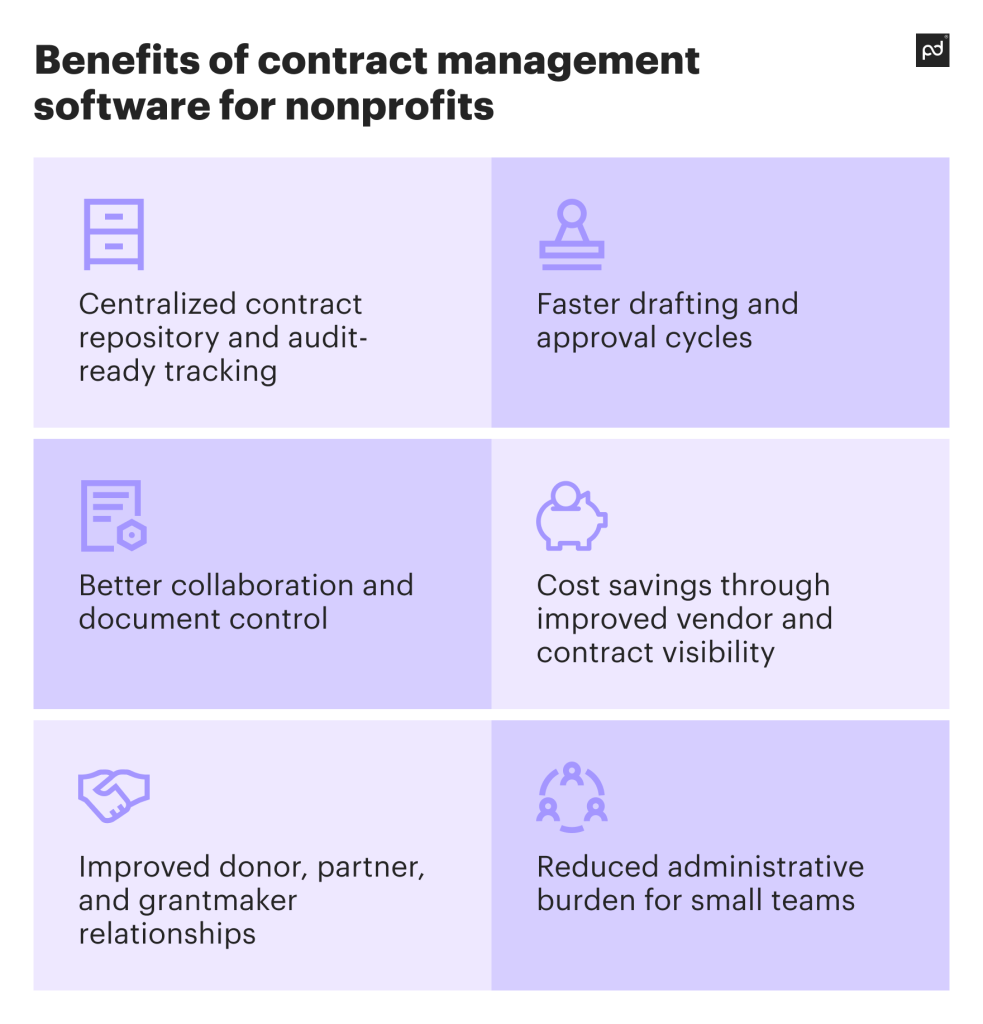
Here’s a closer look at how the key features in most software solutions benefit nonprofit objectives.
Centralized contract repository and audit-ready tracking
A centralized document repository gives nonprofits a reliable system for storing contracts and managing revisions.
Rather than relying on shared drives or disconnected folders, teams can access the right document at the right time. This approach creates consistency in the contracting process while also reducing the chance of working from outdated files.
Audit-ready tracking is common in the systems and can actively support compliance needs. NPOs can easily show a complete history of edits, approvals, and digital signatures to comply with any reporting requirements or internal audits. With clearer records, teams can spend less time preparing documentation and more time supporting the organizational mission.
Faster drafting and approval cycles
The right platform greatly accelerates most contract management processes.
Drafting contracts and agreements becomes easier and faster when teams can generate documents from approved templates or build documents using modularized systems. For example, PandaDoc allows teams to create both full document templates and content snippets that can be stored in the Content Library for later use.
Rather than building each document and element manually, teams can save time and reduce errors by creating documents with a single click or adding specialized blocks and modules on an as-needed basis.
Approvals follow a similar pattern. Contract management software offers reviewers a clear path to follow and sends reminders when action is needed. Plus, because every step happens inside a single platform, teams gain better visibility into a document’s status and who needs to move it forward.
Better collaboration and document control
If using a cloud-based system like PandaDoc, features like version control reduce the need for contract duplication and allow teams to collaborate more seamlessly. This approach works by having teams bring members to a document with access links, rather than sending a document to them via email or PDF links.
If the platform offers built-in tools like commenting and redlining, users can collaborate within a shared file, rather than having each reviewer make corrections separately before consolidating them into a final document. Overall, it’s less work for both stakeholders and contract managers.
This approach also adds a separate layer of protection by providing a single source of truth and keeping track of all changes. As the document evolves, NPOs can more readily review changes and make sure that all clauses and phrasing continue to align with the expectations of grant funders, donors, and internal policies.
Cost savings through improved vendor and contract visibility
When vendor contracts are easy to find and review, nonprofits gain more control over their spending.
While this task might sometimes be handled in CRMs like Salesforce or HubSpot, teams operating on smaller budgets may not be able to justify the cost of those standardized tools. When that happens, relying on reporting and high-level dashboards can help teams track important details like renewal dates, pricing details, and service commitments in one place.
Staff members can identify outdated contracts, reduce overlapping services, and address renewals early. With a clear view of each agreement, teams can stretch their budgets further and invest more in their programs.
Improved donor, partner, and grantmaker relationships
Various features in contract management tools are less about new features and more about smoothing lines of communication between parties.
Powerful contracting platforms can also improve donor relationships with simple features like notifications, personalization, and ease of access. For example, teams using PandaDoc receive notifications when a document has been viewed, opened, or signed, so next steps for any document are always clear.
At the same time, using variables allows NPO teams to build personalized contracts entirely from scratch by creating valuable templates and swapping in details that are unique to a partner organization (company or rep names, physical address, personalized pricing, etc.).
Cumulatively, this allows for better response times and less friction between organizations, which gives any deal the potential to be a huge success story.
Reduced administrative burden for small teams
One of the most important benefits of a contract management platform is that it allows nonprofits to stretch their limited resources even farther.
When headcount is limited and everyone is busy, deploying automated systems can give teams a leg up by minimizing the amount of administrative work required to complete a task. Rather than spending hours creating proposals and contracts, teams can build using pre-approved templates and customized forms, send documents automatically using approval workflows, and give the platform space to automatically manage the process.
While the system handles the contract flows, users can devote more time to mission-critical programs, seek new donors and programs, or shift attention to similar tasks. Long term, those automation features can result in significant impacts on overall productivity.
What to look for when choosing nonprofit contract management software
With so many tools on the market, it can be difficult for nonprofits to decide which platforms actually fit their needs.
The best approach is to focus on software that reduces manual work, supports compliance, and gives teams a simple way to manage documents from start to finish.
Below, you’ll find a list of features that matter the most when creating and managing contracts.
-
Document creation and templates. Templates help teams draft documents quickly and keep language consistent, reducing errors and supporting more efficient workflows. Some platforms, such as PandaDoc, also offer extensive template libraries so teams don’t need to build from scratch.
-
Electronic signatures. Digital signatures shorten approval times and make it easier for board members and partners to sign without delay. While single-function e-signature platforms like Docusign exist, it’s better to seek a contract management solution like PandaDoc, which includes built-in e-signing. Taking this approach means that everything happens inside a single platform, so teams won’t need to pay for a secondary e-signature software.
-
Automated workflows and approval routing. Automation allows documents to move through each stage of the contracting process with clear steps. If the system supports it, it’s also possible to implement rules that will reroute proposals and contracts to a secondary reviewer before sending to a donor or partner. For example, users in PandaDoc can set rules so that if a quote exceeds a certain limit, a supervisor or manager needs to approve it before the document is sent to a customer.
-
Content and clause libraries. Keeping a library of snippets handy allows staff members to modify templated documents in a nominal way while still using approved language. NPOs seeking donors in a specific space might add a snippet or content block targeting that industry or specialization to make a generic proposal more relevant to that reader. This language can be reviewed and approved before being added to the Content Library so that everyone knows it’s safe to use.
-
Renewal alerts and lifecycle tracking. Reminders and notifications can help NPOs avoid missed deadlines. Lifecycle tools show where each contract stands and what action is needed next. If contracts don’t move for a time, notification systems like the one built into PandaDoc can also nudge recipients to encourage movement and keep idle documents top of mind without requiring personalized outreach.
-
Centralized storage with granular permissions. Keeping all documents in a single, shared repository makes things easier to organize and track. Permissions can also limit access levels to the right team members and protect sensitive data from unauthorized access. PandaDoc users rely on account roles for this but can also create custom roles for users that need specific permissions.
-
Reporting and audit trails. Without the right reporting tools, it’s easy to overlook contract status and allocated workloads. Audit trails can keep track of how much work goes into a given document over its lifespan — including revisions and approvals. Meanwhile, reports offer big picture insight that managers and administrators can use to beat milestones and streamline processes.
-
Integrations with nonprofit tools. The best platforms connect with existing systems that nonprofits already use. That might include CRM or accounting tools, as well as project management integrations. At PandaDoc, we offer 40+ pre-built integrations, as well as an API and Zapier connectors to accommodate custom configurations.
- Security, compliance, and access controls. Nonprofits routinely handle sensitive data. Strong, built-in security and access controls reduce risk and support compliance obligations. PandaDoc maintains compliance across a variety of regulations, including support for HIPAA, FERPA, and GDPR.
When these features come together in a single platform, NPOs gain a smoother, more predictable document workflow. Staff can work with fewer interruptions, make clearer decisions, and support programs without getting stuck in administrative tasks.
The one critical factor is pricing. Many enterprise-grade software options require a minimal seat or may set restrictions on the number of documents that can be sent using the platform (as DocuSign does for its e-signature solution). Others may require a minimum headcount that far exceeds an NPO’s budget.
In scenarios where price is a factor, PandaDoc can do most of the heavy lifting at an affordable rate. Very small organizations can add a single use to the Business plan to a bucket list of features. For larger teams, our Enterprise solutions allow for group collaboration and team management that makes document management a breeze.
Why nonprofits choose PandaDoc
Contract management is an important aspect of nonprofit work, but it regularly gets underfunded due to apprehension about the investment.
In reality, an investment in contract management tools can streamline a pipeline and free up staff members to seek new revenue streams and opportunities. Time that is currently wasted managing and maintaining contracts can be put to better use in other parts of the business.
PandaDoc gives teams a clear, organized system that replaces scattered documents and slow approval chains with much smoother processes. Drafting becomes easier and more automated — especially with AI-powered text generation — while reviews move faster, and important records stay safe and secure.
For many NPOs, this shift provides structure and organization that makes reporting and compliance much easier to manage. Teams can work with greater confidence and maintain better alignment between donors, staff members, boards, and external partners.
Ready to give modern contract management a try?
Break away from spreadsheets and word processors. Sign up with PandaDoc free for 14 days, or request a personalized demo with a product expert. We know you’ll love it.