Without proper contract tracking, teams can miss deadlines, overlook key obligations, or leave important stakeholders out of the loop.
Contracts involve multiple steps, versions, and collaborators, often across different departments. Without a clear system in place, the process can quickly become disorganized and inefficient.
This is where contract tracking makes a big difference. In this article, we’ll break down what contract tracking is, why it matters, and how to use it to streamline workflows, boost accountability, and keep your team aligned.
Key takeaways:
- Make monitoring a document throughout the entire contract lifecycle easier with contract tracking.
- Mitigate or eliminate risks such as errors, delays and misplaced contracts.
- Ensure transparency, security and efficiency with contract tracking.
- Deploy a contract management system which provides timeline tracking, document version control and robust security.
What is contract tracking?
Contract tracking is the process of monitoring a contract from creation to end.
You know how it goes.
John from Sales sends Joanne from Legal an email to check if the contract is signed. Joanne is on vacation, so Kim is covering, but she wasn’t involved in drafting the contract. She sends an email to Bill upstairs, and the whole chain slows down.
This kind of confusion and delay is exactly what contract tracking is designed to prevent.
- Contract tracking enables stakeholders to monitor all aspects of the contract throughout its lifecycle, making it easy to track progress and identify issues.
- Its goal is to facilitate efficient contract lifecycle management, eliminating bottlenecks and ensuring all stakeholders are on the same page.
To implement contract tracking in your business, you can either develop a system in-house or use contract management software.
Why contract monitoring is important
Contract tracking gives your team important visibility into obligations, deadlines, and revenue. If you have everything organized and easy to access, your team can see which agreements are active, what needs attention, and any risks to be aware of.
This clarity helps you avoid missed renewals, compliance issues, and expensive mistakes that often come with a manual process.
Another benefit of contract tracking is that it keeps your business moving quickly. You’ll have accurate, up-to-date data, so your teams can collaborate smoothly.
A solid contract tracking system also means better customer experiences, tighter internal alignment, and a predictable contracting process that’s free of manual chaos.
Common risks for poor contract tracking
If you don’t have proper contract tracking in place, there can be a ripple effect that can impact the business. Here are some common contract management risks teams tend to run into.
Errors
Contracts often contain complex, detailed language, so accuracy is paramount.
The risk of making mistakes increases if things aren’t double-checked, and errors can cost a company time and money.
Missed deadlines and delays
If there’s no clear visibility into key dates, you might overlook renewal windows, review deadlines, or expiration dates. This can lead to lapsed agreements or even lost revenue.
The contract can also become stuck somewhere in its lifecycle when you’re busy hunting down documents and trying to track down updates from teammates.
Without contract tracking, these bottlenecks can lead to further delays and friction, frustrating your entire team.
Compliance issues
If you can’t find the latest version of a contract, or you can’t confirm whether the terms of the agreement were met, you’re risk audit problems, regulatory issues, or even legal disputes.
Misplaced contracts
Sometimes, things get lost, especially in busy departments and businesses.
Unfortunately, losing a contract mid-way through the process can put your company back to square one in the contract lifecycle.
Access issues
Each stakeholder needs access to the contract to fulfill their role in its completion.
However, access also needs to be carefully monitored to ensure privacy and security aren’t compromised.
Malicious intent
If those within your organization can edit a contract without evidence of this happening, then malicious actors can easily change the terms to benefit themselves or for criminal purposes.
Contract tracking and monitoring helps to mitigate or eliminate a lot of these risks.
Why is contract monitoring necessary?
If your company manages dozens or even thousands of contracts each year, tracking them is essential.
Contracts cover everything from sales deals and vendor agreements to partnerships and hiring documents. When a contract breaks down, the consequences can be serious. You could lose revenue, damage a key relationship, or end up facing legal action.
When multiple people need access and oversight, managing contracts becomes even more complex.
That’s where contract tracking helps. It keeps everything organized and transparent. You can spot issues early, make sure deadlines are met, confirm everyone is meeting their obligations, and stay compliant. This helps prevent costly mistakes and supports stronger business relationships.
Advantages of contract tracking
We’ve established how important tracking contracts is. Now let’s take a closer look at the advantages.
Transparency
With contract tracking, stakeholders can easily monitor a contract’s progress without having to contact other employees, departments, or organizations.
A simple check-in shouldn’t require four emails, three phone calls, and two working days to get an answer.
All stakeholders have access to the contract, and all access is logged.
This means progress is visible to all relevant parties, and any changes can be traced back to the author.
Security
Contract security can be a real issue, especially when dealing with sensitive information.
Tracking contracts allows for better security, as access is limited to authorized personnel, everything can be monitored and recorded.
Efficiency
The whole point of a contract tracker is to make workflows more efficient.
Giving stakeholders oversight regarding contract progress cuts down on the constant emails and phone calls we talked about, reducing delays and friction between teams.
Should any bottlenecks occur, they can be quickly located and fixed to get things moving again.
Contract tracking vs. contract monitoring
Contract tracking focuses on organization and visibility. That means contract data like dates, obligations, documents, and terms, allowing teams to see where everything stands at any given moment with a contract.
Contract monitoring is a broader process that encompasses contract tracking. It’s more of an ongoing process that involves evaluating performance, making sure obligations are met, reviewing KPIs, and finding issues before they become big problems.
Think of contract tracking as the specific, tactical activity within the contract lifecycle, and contract monitoring as the more comprehensive, strategic process that tells you how well the contract process is being executed.
What should be tracked in a contract?
All contracts should include key dates and milestones. That means start and end dates, renewal windows, review deadlines, payment schedules, and anything else that’s time-sensitive that could impact performance or compliance.
Tracking these dates properly will help your team plan ahead instead of having to scramble at the last minute.
You also want to have a good view of obligations, deliverables, and any compliance or termination clauses. Tracking who’s responsible for what and by what date will help avoid missed commitments. This will also protect all parties from unnecessary risk.
Now let’s dive into the components of contract tracking.
See also: How to terminate a contract and end terms
Essential components of contract tracking
To keep contracts moving smoothly and securely through their lifecycle, your contract tracking process should support clear communication, visibility, and accountability. Whether you’re using manual methods or an automated platform, make sure your system allows you to follow the full contract journey from draft to signature and after.
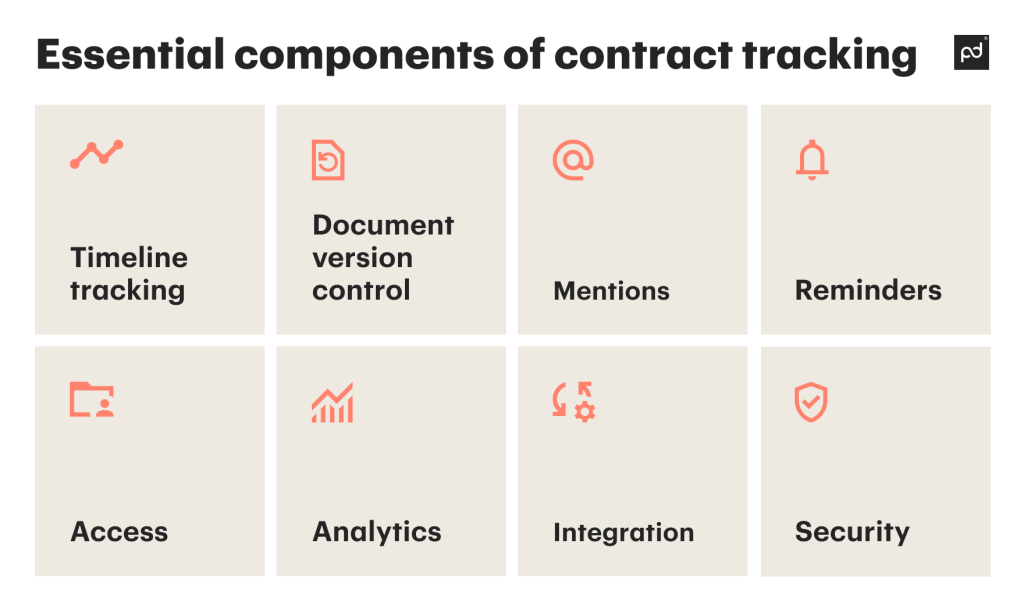
1. Timeline tracking
Monitor the timeline of your contract to keep track of who did what and when. You can do this manually, or you can use document tracking software to speed up the process.
Any edits, additions, or subtractions should be logged along with the author to ensure contract integrity.
You can also keep track of renewal dates and negotiation windows and check signatures and milestones to keep your contract moving swiftly through its lifecycle.
2. Document version control
Contracts typically go through multiple revisions, known as redlining.
Each stakeholder needs access to the latest version of the document, as well as a way to access older versions and track the changes made to each version.
Being able to track these changes gives all parties total transparency over edits and the confidence that no words or terms have been changed or added without approval.
3. Mentions
Include ways to tag people, too, so that if something needs attending to, that person will be notified immediately.
4. Reminders
Use reminders to keep your contract schedule on track. Reminders can prompt stakeholders to complete tasks, check progress milestones, and set start, end, and renewal dates.
5. Access
Make sure your contract tracking system allows access controls. This ensures that everyone who needs access has it and that access can be approved and revoked as necessary.
PandaDoc makes this easy with content locking and document version control. You can lock down specific sections of a document, like pricing tables or legal terms, so only certain team members can edit them. You can also control who can view, comment on, or send documents based on their role or workspace permissions.
6. Analytics
Analytics can help you analyze the contract tracking process to figure out what’s working and what isn’t. If there are any roadblocks hindering your workflows, analytics can help you identify and fix them.
7. Integrations
Your company probably uses a variety of technical solutions to operate, such as communication, accounting, and office software, for example.
Being able to integrate your contract management solutions with your existing tech stack will make the monitoring process smoother.
For instance, being able to share documents with colleagues for editing within your contract management system is easier than emailing a PDF back and forth.
Additionally, integrating with CRM systems allows your sales team access to important sales contracts. They can track contract timelines, get notifications, and follow up on any delays.
You can build your contract management setup around your existing software, or look for third-party solutions that offer the integrations you need.
PandaDoc integrates with tools like Salesforce, HubSpot, Google Docs, and over 30 others, so your team can create, send, and track documents without switching platforms.
8. Security
A good contract management system should shore up your security.
Access controls, for example, ensure that only approved parties can access secure documents, and timeline monitoring can log the source of any edits.
If you decide to automate, be careful to choose the best contract management software for your needs.
Do your research and look for positive reviews and testimonials or recommendations from trusted peers.
How to track contracts effectively
When you have the right tools, contract tracking is much easier, not to mention more accurate.
Here’s what you can focus on to be more effective:
- Manual vs. automated tracking: Manual tracking, like spreadsheets, shared folders, and email alerts, can work for small teams, but this system doesn’t work as well when your business scales. Automated tools can help you control reminders, updates, and data capture. This will help make sure nothing gets missed.
- Centralize your contracts: Having all your agreements in one centralized location will help avoid confusion and lost documents. A repository is key for finding files, tracking status, and keeping your teams aligned in a breeze.
- Standardize your process: Using standardized templates, language, and workflows will make sure all your contracts are consistently accurate.
- Track key data points: Always capture key dates, obligations, stakeholders, and status updates so you always know where an agreement stands.
- Use alerts and notifications: Automated reminders are great for renewals, approvals, and milestones, so you have less manual follow-up.
Contract tracking procedures
Contract specifics may vary, but most will generally follow a similar trajectory from creation to completion.
- Create. The contract is requested and drafted.
- Edit. The contract is viewed and edited internally by the relevant team.
- Review. The contract is reviewed by legal teams and checked for potential risks.
- Approval. The contract is approved by the team responsible for creating it.
- Negotiate. Redlining begins. The contract goes back and forth between parties to suggest edits and negotiate terms.
- Sign. Both parties reach an agreement and sign the contract. The document is now a legal contract, and both parties begin fulfilling their roles.
- Store. The contract is stored somewhere safe and accessible to all stakeholders.
- Track. Contract milestones are monitored. The contract can be accessed by all parties to track the timeline. Any delays can be caught early and resolved.
- Performance. Contracts are analyzed to study how well they’re performing. If KPIs aren’t being met, issues can be resolved and improvements can be made.
- End or renew. The contract either completes with no further action or is renewed for ongoing collaboration.
Contract tracking can simplify, speed up, and improve the security of each of these milestones.
Best practices for contract tracking to ensure efficiency
The purpose of contract management is to promote a more efficient workflow. To do this, it’s important to consider a few best practices for contract tracking.
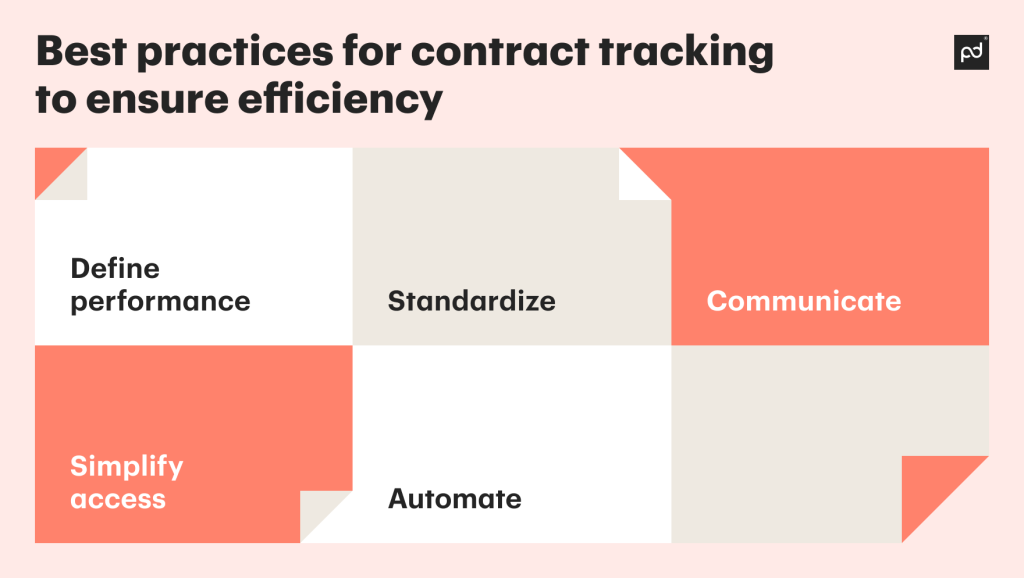
Define performance
What do you want from your contracts?
Which key performance indicators (KPIs) can you use to determine if the terms of your contracts are being fulfilled?
Once you’ve defined your KPIs, you can use contract tracking to measure them.
For example, maybe you’re concerned about the length of time between contract creation and signing in your company.
Are your drafting and approval taking too long? Is your contract going back and forth between parties?
You might conclude that your process needs better standardization and more communication.
You can track your progress toward these goals using your selected KPIs.
Standardize
Speaking of standardization, drafting every new contract from scratch isn’t very efficient, and monitoring contracts on-the-fly puts you at risk of overlooking things.
Having your legal department develop contract templates will cut down on drafting time. It also means other departments can draw up contracts without having to contact Legal first.
Standardizing the contract tracking process can help you set defined milestones that your contracts need to hit to succeed.
This means you can hold contract creation to a higher and more uniform standard moving forward.
Communicate
On the topic of communication, good communication between stakeholders is essential.
Luckily, contract tracking facilitates a level of transparency that fosters greater trust and improved collaboration.
Simplify access
To make access easier, contracts should be stored somewhere centralized and searchable.
This way, stakeholders can quickly get hold of the information they need without having to hunt down Joanne from Legal.
Automate
Manual contract monitoring can work for some companies, but the value of automating the process can’t be overstated.
Using contract management software means you can automate all these best practices for monitoring your contracts.
For large companies that handle high volumes of complex contracts, a contract tracker is an invaluable tool; for individuals and small companies, manual contract tracking might be sufficient, but automating some or all of the process is still worth considering.
Features to look for in contract tracking software
When you’re choosing the right contract tracking tool, you’ll want to focus on a few key features:
- Centralized repository: This will keep all contracts in one secure, searchable place.
- Smart search: This feature will help you find documents quickly using keywords, metadata, or clauses.
- Automated alerts: These alerts will remind you of key dates like renewals, expirations, and milestones.
- Workflow automation: Reviews, approvals, and routing are much simpler with an automated workflow.
- Template and clause library: Drafting is much faster when you have standardized documents to pull from.
- Version control and redlining: These features allow you to track changes and compare edits easily.
- eSignature integration: Contracts can be executed and signed faster with a fully digital process that includes secure eSigning.
- Reporting and analytics: Having access to insights on deadlines, cycle times, and risk helps you get a better understanding of effectiveness and performance.
- Security controls: With role-based access, encryption, and full audit trails, your contracts stay safe and your data secure.
- Integrations: Being able to sync your contract tracking tool with your CRM, ERP, or storage tools will make for smoother workflows.
Use PandaDoc contract management software for efficient contract tracking
For better efficiency, transparency, collaboration, and security, contract tracking software is worth a try.
PandaDoc’s contract management software lets you design and craft templates, negotiate contracts with stakeholders, collaborate with colleagues, and store and manage your contracts all in one place.
Request a demo to try it today!
Frequently asked questions
-
A contract tracker is a tool that helps you organize, store, and monitor the details of your contracts. This includes dates, obligations, documents, status updates, and more.
-
Contract monitoring is the ongoing process of checking contract performance, making sure obligations are met, and finding risks or problems when they come up. Contract tracking is a component of contract monitoring, which is all about capturing data of the contract’s lifecycle. Monitoring evaluates how the agreement is being executed throughout its lifecycle.
-
Contract tracking software automates the process by logging contract data, sending alerts for deadlines, routing documents for review, updating contract statuses, and centralizing files. It helps by cutting out the need for manual follow-ups and avoiding missed deadlines and outdated information.
-
You want to choose KPIs based on your goals. Some common metrics are cycle time, renewal rates, compliance rates, contract value, milestone completion, and more. The goal is to choose KPIs that will help you be more efficient, reduce risk, and improve performance related to revenue.
Disclaimer
PandaDoc is not a law firm, or a substitute for an attorney or law firm. This page is not intended to and does not provide legal advice. Should you have legal questions on the validity of e-signatures or digital signatures and the enforceability thereof, please consult with an attorney or law firm. Use of PandaDocs services are governed by our Terms of Use and Privacy Policy.
Originally published July 27, 2023, updated November 24, 2025