

Sales teams rely on accurate data to create complete solutions and build strong, ongoing customer relationships. Both are key in modern business, where customers expect fast responses and precise quotes during the buying process.
However, when pricing and product information live in separate systems, quoting becomes a manual task prone to errors and inefficiencies. Systems are disconnected from one another, and reps are forced to bridge those gaps through manual processes and mental gamesmanship.
But it doesn’t have to be that way.
CPQ (Configure, Price, Quote) integrations can bring everything together by connecting your CRM, pricing data, and document workflows to one another. When done correctly, these connectors make it easy for teams to create quotes based on real-time data and approved pricing rules.
In this article, we’ll explore how CPQ integrations work, why a unified tech stack is essential for modern sales teams, and how CPQ solutions like PandaDoc can help you manage quoting, e-signing, and payments in one streamlined process.
Key takeaways
-
CPQ integrations connect quoting systems to essential business information, as well as processes like approvals, e-signing, and payment collection, to create a unified tech stack.
Integrated workflows reduce manual work and errors, allowing reps to respond faster and with greater accuracy while leveraging the most up-to-date product information.
CPQ-based pricing rules and automations provide checkpoints for review, so teams can validate that every quote aligns with company standards before it reaches the customer.
CPQ solutions differ in scope and capability. Some features that are built into one platform may only be available on others when using pre-built integrations or API connectors.
What is CPQ integration and how does it work?
A CPQ integration connects quoting tools to systems that store product, pricing, and customer data. Rather than entering details manually, sales reps can pull accurate information directly from platforms like CRMs or ERPs and connect them to the CPQ in order to generate accurate quotes in minutes.
By combining these systems, CPQ integrations help teams configure complex products, apply approved pricing and discount rules, and deliver accurate, professional quotes at speed. These connectors can also improve cross-team collaboration, since the changes that product and finance teams make to the inventory or purchasing process are mirrored in the CPQ sales flow.
For example, if the product team updates pricing in a CPQ-integrated database, that new pricing information is automatically reflected when the next quote is built. Similarly, if finance teams want to implement new discounting rules, these can be implemented through CPQ rulesets while the informational changes take place in a CPQ-connected database.
The result is a more consistent quoting process and a smoother experience for both sales teams and customers. Reps can build the order using familiar tools, while information is pulled directly from the appropriate database and seamlessly integrated with the ordering process. Buyers also receive custom quotes faster, as reps can build solutions in real-time that are tailored to a customer’s specific needs.
CPQ tools can also integrate with other components of your sales architecture — including contract management, e-signature, and payment platforms — to create a complete quote-to-cash workflow. Using this setup, teams can transition quickly from building quotes to sending contracts and collecting within the same, unified environment.
How CPQ integration benefits your business
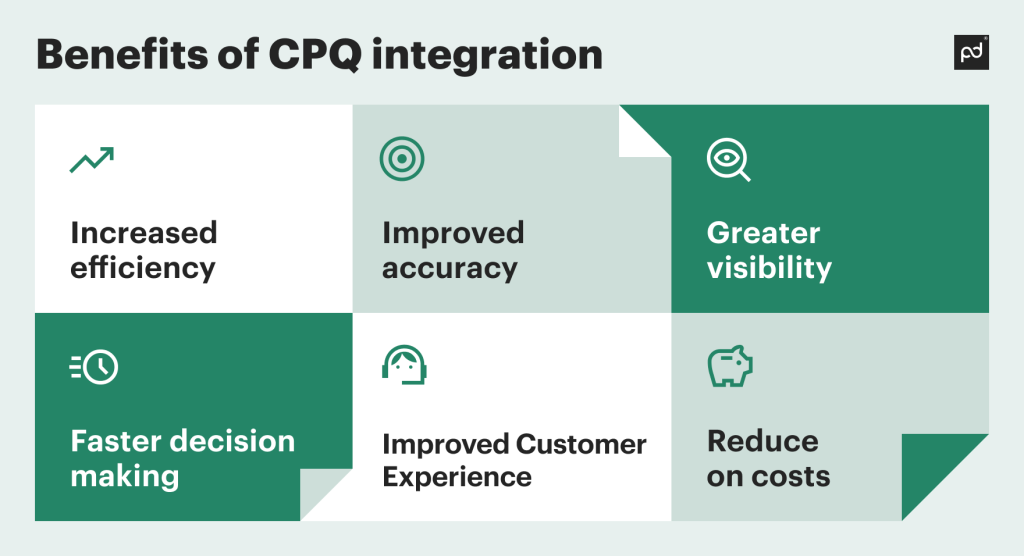
Integrating CPQ software with a brand’s existing tech stack improves team productivity by limiting the amount of manual tasks and system switching required to build strong quotes.
In a CPQ-integrated system, reps don’t need to juggle spreadsheets or hop through multiple systems in search of pricing data. Everything is connected, and reps can access that data during the quoting process. Rules-based logic can also be implemented so that, when certain conditions are met, things like discounts or review workflows are automatically applied.
Here’s a closer look at how CPQ integrations can make a measurable difference in any business.
-
Accelerate the sales cycle. When quoting tools connect directly to a CRM or ERP, reps no longer need to search for the correct data or manually update pricing details. Quotes can be generated and customized using live product and customer information, helping teams respond to opportunities with greater speed and accuracy.
-
Reduce human error. By pulling verified data from connected systems, CPQ integrations eliminate the need for manual data entry and associated mistakes. Every quote reflects the most up-to-date product details, pricing, and discounts, and none of that data needs to be keyed into the quote by hand.
-
Ensure pricing accuracy. Built-in pricing rules make sure that every quote aligns with current company policies. Reps can apply discretionary discounts while system rules automatically apply discounts for product bundles, loyalty programs, and special deals. If manual changes exceed minimum thresholds, approval workflows can automatically route a quote for manual review before the quote is sent to a customer.
-
Improve cross-department alignment. When the quoting process is connected to other systems, everyone stays on the same page. When product updates, pricing adjustments, and inventory changes are applied in other systems, those updates are automatically reflected in the CPQ and applied to future quotes.
-
Streamline approvals and e-signing. Integrating CPQ with contract management and e-signature platforms allows teams to move directly from quote correction to contract execution without switching tools. Long term, this reduces administrative delays and helps deals move smoothly through every stage of the sales cycle.
- Scale operations with confidence. As businesses grow, connected systems make it easier to manage complexity. Automated workflows can improve accuracy and compliance, even as product catalogs expand and pricing models evolve.
When connected to other parts of your tech stack, CPQ platforms help companies and teams deliver faster, more accurate quotes while reducing mental burdens. These unified systems offer better consistency for sales operations and create a foundation that supports growth, transparency, and better customer satisfaction.
All-in-one platform
7 Most popular CPQ integrations
Every company uses a slightly different combination of tools to manage sales, pricing, and customer data. The value of a CPQ system comes from how well it connects those tools. By integrating CPQ with other commonly used platforms and solutions (CRM, ERP, payment processing, etc.), teams can create an interconnected environment where data moves freely and accurately between systems.
The right integrations can create CPQ-centered, consolidated workflows, where sales teams work from a single source platform and can build quotes without needing to switch between tools. Because all systems are connected, quotes always reflect current pricing, available inventory, and approved discount structures.
Not only do customers benefit from faster and more accurate quotes, but built-in rules and guardrails protect reps and the brand from common missteps like incorrectly applied discounts, missed guided selling opportunities, and protracted sales cycles.
Below, we’ve compiled a list of common software solutions and how they integrate with CPQ systems. However, keep in mind that API-based solutions like those made possible with PandaDoc API mean that CPQ systems can heavily integrate with software options not included in this list.
Customer relationship management (CRM) software
Integrating a CPQ with a CRM platform is one of the most effective ways to streamline the quoting process. CRMs like Salesforce, HubSpot, and Pipedrive house critical customer data that is commonly required for quotes, proposals, and contracts.
When connected to a CPQ, CRM data can flow directly into quotes, completely eliminating the need for manual data entry. In PandaDoc, teams handle this by creating templates with embedded variables and then mapping those variable data points within the CRM. When the CRM passes the data to PandaDoc, those details replace the in-document placeholders within the quote. Reps never need to re-key the data.
The best CRM solutions also offer two-way data syncing between the CRM and the CPQ. This functionality allows teams to build and send branded quotes directly from the CRM interface. Sales managers can also gain better visibility into deal progress and pricing forecasts, because the CPQ system reports when quotes are opened, signed, or require specific action in order to move down the pipeline.
Enterprise resource planning (ERP) software
ERP software helps teams align various back-end portions of the sales and logistics process. By connecting a CPQ to ERP platforms like Microsoft Dynamics, NetSuite, and SAP, the sales team can get accurate information on inventory levels, product availability, manufacturing costs, and current pricing.
For example, if inventory levels or materials costs change, that updated information can flow automatically to the CPQ system. The next quote that a rep creates will already account for the latest information, which helps to prevent delays, stockouts, or margin errors.
On the front end, reps can steer customers away from solutions that can’t be immediately filled or notify buyers of extended wait times when inventory levels are low. Overall, this creates a more informed buying experience, where reps have the information necessary to set the appropriate expectations with customers.
Product and pricing database tools
Some companies manage product and pricing information outside of traditional CRMs or ERPs, often through dedicated product information management(PIM) databases or similar configuration tools. Standalone solutions like SolidWOrks, Teamcenter, or OpenBOM can provide detailed product data and configuration options that feed directly into the quoting process.
Integrating these platforms with a CPQ (done via API with PandaDoc) brings that information into the quoting process in a similar way to ERP/CRM integrations and allows quotes to reflect the most current SKUs, specifications, and pricing numbers. For companies offering complex or built-to-order products and solutions — especially those where small variations can significantly impact pricing and delivery timelines — CPQ integrations greatly improve accuracy and help reps provide realistic timelines for builds and customization.
When connected to PIM systems, sales reps can configure products inside the CPQ without needing to consult multiple sources or recheck engineering specs. Because the data is shared, departmental information is consistently portrayed across all teams, instantly resolving much of the back-and-forth found in manual quoting processes.
Productivity solutions
Integrating with productivity tools like Slack or Microsoft Teams allow collaboratively focused teams to stay connected and focused during the sales lifecycle. Using these tools allows reps and supervisors to receive instant notifications when key actions occur, such as when a quote is created, approved, or signed.
Mileage on this functionality is likely to vary with the CPQ itself. For instance, PandaDoc offers eight different notification types for documents created on the platform. These include when documents are opened or completed, when suggestions are added, when comments are posted, and more. By integrating with Slack, teams can be notified as soon as documents are actioned and accepted.
Unlike most of the other integrations on our list, productivity tools won’t drastically change the functionality of the CPQ. However, they do a great job keeping teams informed and make it easier to track deals as interactions take place.
E-signing and document automation platforms
If the CPQ you choose doesn’t have integrated e-signing or document automation, teams may need to integrate with third-party solutions that offer such functionality. Both aspects are critical to the sales cycle, as document automation helps teams create documents quickly and e-signing helps to finalize and close deals.
Some CPQ solutions may force teams to integrate with dedicated platforms like DocuSign or Dropbox Sign for faster sending, signing, and tracking. In a similar fashion, CPQ tools that produce simple quotes might need integration with document platforms equipped to handle contracts and formal proposals. (Note: PandaDoc combines CPQ, document automation, e-signing, and several other tools into a single, unified platform.)
Both e-signing and document automation are essential components to the sales process. Combining them into a unified workflow reduces manual steps, shortens turnaround times, and allows deals to move more seamlessly through the sales pipeline.
Payment and billing solutions
Connecting payment and billing tools with a CPQ system creates a smooth end-to-end experience throughout the quote-to-cash process. Once a customer accepts a quote, billing information and payment links can be generated automatically, so sales teams can close deals faster and without extra administrative work.
Platforms like Stripe, QuickBooks, Xero, or Chargebee can connect directly with CPQ workflows to handle invoicing, subscription billing, or one-time payments. Plus, if connected to the rest of your tech stack, teams can rest assured that pricing data and customer details will remain accurate across all systems without the need for manual handoffs.
PandaDoc users enjoy built-in CPQ processes for payment collection via a formidable selection of pre-built integrations. Customers can review, sign, and pay in a single step, while accounting teams receive accurate payment records instantly. This results in a more efficient and transparent workflow for brands and customers alike.
API connections
While we’ve mostly covered pre-built integrations in the other sections, it’s worth pointing out that API connectors offer customization far beyond what pre-integrations allow. APIs give businesses the flexibility to connect their CPQ systems to nearly any platform or internal tool, enabling for highly specific workflows that can align with unique business needs.
Using APIs, CPQ platforms can exchange data with business intelligence tools, e-commerce storefronts, and even 3D product configurators. This level of customization makes it possible to automate niche processes, synchronize complex datasets, or deliver dynamic pricing directly via a customer-facing UI.
For example, a company could use an API connection to pull accurate pricing data from a manufacturing database, push that information to the CPQ, and then display updated quotes in real time on its website. Using PandaDoc API, brands can build flexible, fully connected quoting systems that align with the workflow and customer experience they want to provide.
How to integrate CPQ with other systems
Once you’ve identified which tools and platforms your team uses the most, the next step is deciding how to connect them to a CPQ system. The right integration method will depend on your tech stack, budget, and how much customization you ultimately need.
Most businesses start with pre-built integrations for speed and simplicity, especially when using popular CRMs and ERPs. It’s also possible to rely on third-party connectors like Zapier to automate data sharing when a native integration isn’t available, although this comes with some costs. API connections provide the greatest flexibility to create fully custom solutions, but these typically require in-house development.
Let’s take a look at each of these options.
Use a pre-built integration
Pre-integrations are the fastest and easiest way to connect your CPQ system with an existing tech stack. Most major platforms (Salesforce, Slack, Stripe, etc.) offer native CPQ integrations that can be activated with minimal setup.
Most of the time, these integrations handle data exchanges for common information like customer details, product info, or pricing updates. However, because the connections are pre-built and usually maintained by a product team, they may not offer data solutions or customization options that meet every scenario and use case.
For many brands, pre-built integrations offer the perfect balance between convenience and functionality. Teams can connect their tools and start working quickly, without the need for custom development or complex configurations.
At PandaDoc, we offer 40+ native, pre-built integrations to connect our CPQ and document solutions with major CRM, productivity, and payment tools.
Use a third-party connector
A third-party connector (also called middleware) is a type of integration that connects two or more apps that can’t otherwise interact with one another. They’re a half-step between native integrations (above) and API-based development (below) in that they allow the creation of custom workflows, but not at the level you’re likely to see with a dedicated developer.
Platforms like Zapier or Make (formerly Integromat) fall into this category. Each can act as a bridge to pass information between a CPQ and another application based on custom triggers and actions.
However, while these solutions can be used to create custom workflow without requiring deep technical knowledge, they come with added costs. Most third-party connectors charge for that connectivity using a token-based system. The more you use the connector, the more you’ll ultimately pay. This puts them a step below native integrations, which are usually free. Over time, constant usage may even exceed the cost of API-based custom development.
Connect via API
For teams with advanced technical capabilities or highly-specific workflow requirements, API connections offer the greatest amount of control and flexibility. Using an API, teams can create fully custom integrations that align perfectly with the way the business operates.
When connected using API tools, CPQ solutions can exchange real-time data with virtually any platform, including inventory databases, ERP systems, analytics dashboards, and custom-built applications. In many such cases, native integrations don’t exist or lack the functionality that a certain flow or process requires. APIs offer a way around those limitations.
PandaDoc API gives brands the freedom to integrate quoting, document creation, and e-signing functionality directly into their own software environment. That’s a huge benefit for brands using custom or proprietary software, as it allows companies to continue with their preferred software while still taking advantage of the configuration and quoting features that a CPQ system can provide.
Explore the power of PandaDoc CPQ integrations
Connecting your quoting process to the rest of your sales workflow can feel overwhelming, especially if you need to juggle multiple independent systems to do so.
However, it doesn’t have to be that way. Using PandaDoc, teams can configure, price, and quote in one platform while staying connected to the tools they use every single day.
PandaDoc integrates natively with multiple CRMs, payment, and productivity solutions.
Because PandaDoc combines so many common sales tools (document generation, e-signing, CPQ, payment collection, etc.), we’re a great fit for companies that want to trade complicated tech stacks for streamlined, all-in-one sales and document workflows.
See what we mean by signing up for a free 14-day trial or talking with a product expert to learn how PandaDoc can simplify your entire quoting process with minimal setup.
Frequently asked questions
-
CPQ integration smoothes out the sales process by automating quoting, pricing, and approvals. This means less manual work, faster sales cycles, and fewer errors.
Plus, CPQ platforms improve the accuracy of sales quotes delivered so that reps can offer custom solutions faster, which means higher productivity, better closing rates, and larger average deal size.
-
CPQ stands for “Configure-Price-Quote.” This software helps businesses quickly generate accurate, professional quotes for complex products or services. It makes sure that all pricing is consistent while automating approvals. This leads to better selling.
Dive deeper into the ins and outs of CPQ software here.
-
No. While the acronyms are similar (CPQ, CRM), each software serves a very distinct purpose.
- CPQ software provides configuration, pricing, and quoting tools to streamline the sales process.
- CRM systems act as a repository for customer data and helps teams manage relationships while tracking sales activities.
However, while different, these solutions pair well together. Many sales teams operate almost exclusively inside a CRM. By creating a CPQ-CRM integration, teams can quickly create quotes using customer and product information stored in the CRM database.
After sending the quote, the CPQ will notify reps via the CRM when a document has been opened or actioned. From there, reps can jump in and push to close while the deal is still top of mind.
-
A CPQ API allows developers to connect a CPQ system with other platforms or create custom functionality that aligns with a brand’s unique needs.
Through an API, businesses can automate pricing, synchronize data across tools, or embed quoting features directly into their own applications.
-
ERP systems usually manage inventory, supply chains, production, and financial data while CPQ tools handle pricing and product configurations. Integrating CPQ systems with ERP integrations allows teams to bridge the gap between front-end sales and back-end operations.
When connected, CPQ systems can look at the data that ERP platforms provide and use it to more accurately reflect product availability, production times, overall costs, and other business constraints. Without this connectivity, reps may create quotes for low-stock products with longer production times, leading to elongated sales cycles and long waits for customers.
Originally published March 7, 2024 and updated November 14, 2025
Disclaimer
Parties other than PandaDoc may provide products, services, recommendations, or views on PandaDoc’s site (“Third Party Materials”). PandaDoc is not responsible for examining or evaluating such Third Party Materials and does not provide any warranties relating to the Third Party Materials.