Contracts are a fundamental part of business operations, and the stakes are often high. A brand’s profits and growth depend on its ability to deliver within the agreed-upon terms of a deal. Failure to do so can result in financial penalties, reputational loss, and legal trouble.
Despite these risks, many companies still manage contracting processes manually. As contract volume increases, it becomes harder to maintain visibility and control without a consistent process. This opens the business up to unchecked risk as teams lose track of commitments.
While it’s not possible to mitigate all risk, many issues stem from the terms agreed to at signing and how they are managed over time. Fortunately, a mix of automation and clear guardrails can reduce exposure and prevent avoidable problems.
In this article, we examine the most common contract management risks and how to keep contracts moving safely forward.
What are contract management risks?
Contract management risks refer to the negative business outcomes that occur when contracts are not properly tracked, enforced, or managed over time.
These risks develop gradually as gaps in visibility, ownership, and processes go unaddressed, ultimately preventing the company from fulfilling its contractual obligations. As the organization misses deadlines or fails to provide the required goods or services, penalties in the contract trigger those negative outcomes.
Here’s a quick list of the most common contract management risks any business will face:
-
Financial loss. Poor contract oversight can result in missed renewals, unfavorable pricing, uncollected revenue, or penalties tied to unmet obligations.
-
Legal exposure. Contracts that are outdated, inconsistent, or improperly enforced can expose a business to disputes, regulatory violations, or unexpected liabilities.
-
Operational disruption. Poorly tracked contractual obligations lead to missed deadlines, commitment failures, and confusion across multiple teams.
-
Security breach. Weak access control, unsecured storage, or limited auditability can create data breaches and leaks that result in compliance issues, legal action, and other harsh penalties.
- Reputational damage. Failure to fulfill a contract can undermine trust with potential customers, partners, and stakeholders, ultimately generating bad publicity and long-term impacts around brand perception.
Depending on the nature of the contract, each of these risks have the potential to escalate, resulting in serious liabilities that will ultimately disrupt growth and eat into annual profits.
In the following sections, we’ll take a closer look at each of these risks in greater detail.
Why does contract risk occur?
Risk is unavoidable when accepting a contract. Typically, one business agrees to specific terms where they need to supply goods or services to the counterparty within the scope of a deal. In doing so, that business must accept the risks that accompany that fulfillment.
Example: Acme Paper signs a vendor supply agreement, where Acme Paper agrees to supply another party with 5,000 reams of paper per month. In doing so, Acme commits to using a portion of its stock and supplies to create that product (the paper) specifically for the buyer. Failing to deliver would result in a breach of contract that could expose the company to potential liabilities, penalties, or damages.
While this example is simple, contracts and related terms can become far more complex. Any type of goods or services might be exchanged, but the fundamentals of risk, reward, and enforceability are almost always the same.
For many brands, the problem isn’t the risk involved in one contract; it’s the compound risk that comes from handling multiple contracts at a time. Especially for businesses relying on manual workflows, it’s easy for critical details like obligations, renewal terms, approvals, and changes to become difficult to track and manage. When that happens, teams lose track of what needs to be done to stay compliant across multiple commitments, leading to a breach and potential exposure.
On top of that, inexperienced teams may treat contracts as static documents rather than active agreements that require ongoing oversight. Without clear processes to monitor performance, enforce terms, and manage updates, even well-managed contracts can introduce unexpected exposure.
The good news is that most contract risk can be managed appropriately through a mix of automation and standardization. Strong contract management platforms can help to clarify inconsistent processes and improve accountability so that risks and obligations are easier to manage.
What are the risks of a service contract?
In addition to defining deliverables, service contracts outline things like performance, timelines, and penalties for non-compliance, making their risks unique. When these elements are left too vague or are not managed properly, all parties can be left vulnerable.
Here are some key risks of a service contract to keep in mind:
- Scope creep: Without clearly defined services, one party might be asked to do more than was originally agreed upon, without the fair compensation to go with it.
- Failed performance: If SLAs are missed or deliveries are delayed without the customer fully understanding these expectations, they will likely be dissatisfied with the provider, especially if penalties are involved.
- Liability exposure: If terms are written poorly, you might be expected to pay for damages or disputes that you didn’t anticipate.
- Termination issues: If exit clauses are too vague, this can lead to surprise contract renewals and even drawn-out legal battles.
When it comes to effective contract management, the goal is to minimize ambiguity and prevent misunderstandings that can be costly. To do this, all expectations need to be clear, measurable, and enforceable.
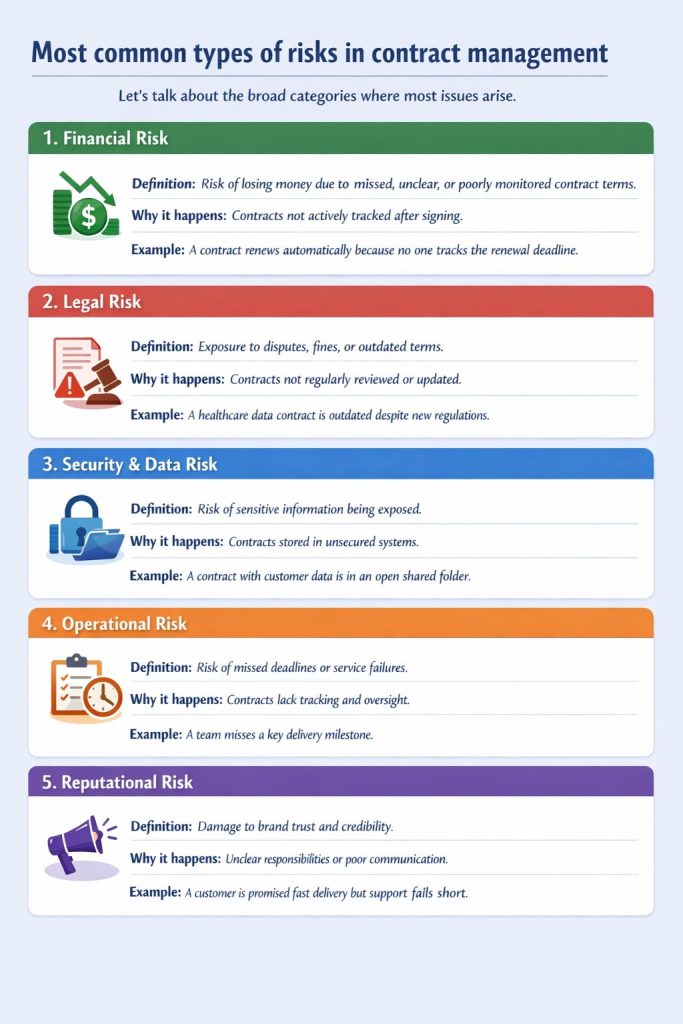
Most common types of risks in contract management
Let’s talk about the broad categories where most issues arise. Here are the top contract management risks you should know:
1. Financial risks
One of the most common outcomes of poor contract management is financial risk, the possibility of losing money due to how contract terms are tracked, enforced, and executed over time. This can include direct costs, such as accidentally paying for unwanted services or incurring penalties for noncompliance, as well as indirect costs, such as inaccurate forecasting or reduced negotiating leverage.
Financial risks often arise when contract terms aren’t clearly understood or actively monitored after signing. When agreements are tracked across multiple systems, details regarding pricing, renewal terms, payment schedules, and penalties can go unnoticed. As a result, brands may continue paying for services they no longer need, miss opportunities to renegotiate terms.
Example: A contract renews automatically because no one tracks the renewal deadline. The business continues paying for services that are no longer fully used, locking unnecessary costs into the budget for another contract term.
Because these renewal dates aren’t tracked, this occurs several times throughout the year, resulting in thousands of dollars in unnecessary operating costs.
This risk also runs in the opposite direction. Companies that purchase services may fail to track performance metrics or confirm that vendors comply with the established agreement. In doing so, teams may not realize they can collect additional revenue by exercising the terms and provisions of the contract they set up!
When financial risks go unnoticed, they can disrupt budgeting, strain cash flow, and detract from the bottom line. With enough time, these oversights will turn into major financial liabilities that can cost companies thousands or millions of dollars.
The worst part about the entire affair is that these risks are easy to track with the right software. Solutions that track documents through their entire lifecycle can help teams stay on top of financial risks before they spiral out of control.
How to identify financial risks
-
Review any active contracts. Create a list of renewal and expiry dates. If this information isn’t already tracked in a centralized system, leverage dedicated renewal software to automate tracking and prevent accidental renewals.
-
Compare pricing and payment terms across all contracts. Look for inconsistent rates, outdated discounts, or fee structures that may be increasing costs without delivering additional value.
-
Identify contracts with penalties, service credits, or performance-based fees. Confirm whether the milestones tied to those terms are being tracked or enforced. Billing schedules, payment timelines, and late-fee provisions need to be recognized and collected as intended.
- Examine how teams access financial contract data. If costs or revenue details require manual interpretation, spreadsheets, or back-and-forth emails, financial risk may already be present.
2. Legal risks
Legal risk refers to the exposure that a business faces when contracts contain outdated, inconsistent, or unenforceable terms. These issues can arise if agreements fail to reflect current laws, regulatory requirements, or internal legal standards, leaving organizations vulnerable to disputes, fines, and unexpected liability.
Regulatory frameworks evolve over time, and agreements that aren’t regularly reviewed and updated may no longer meet the legal requirements necessary to keep the company safe. On top of that, inconsistent terms around liability, indemnification, termination, or dispute resolution can weaken a company’s legal position if a disagreement escalates.
Example: A data security company has an established contract with a healthcare organization that has been in place for several years. Since the contract was signed, regulations governing patient data handling and reporting obligations have changed.
When an issue arises, the data security company discovers that the language in the agreement no longer provides adequate legal protection, leading to costly remediation and potential fines. Because the laws changed and the contract wasn’t updated, the protections in the contract are no longer valid.
Legal risk can also be amplified when similar agreements contain conflicting terms. If contracts and clause language aren’t standardized, the company may accept higher levels of liability in some contracts than others. This can make legal liability difficult to assess and control, because terms vary between agreements.
Left unchecked, legal risks can lead to prolonged disputes, regulatory penalties, and reputational damage. As outdated terms drive up legal costs, a company may no longer be able to enforce its agreements with confidence.
Fortunately, contracting solutions with dedicated content libraries and templating tools can make it much easier to review and maintain agreements.
How to identify legal risks
Assess how legal oversight continues after contracts are signed. If legal review ends at execution and contracts aren’t revisited as laws and business practices evolve, legal risk may already be present.
Inventory active contracts and note their review dates. Contracts that haven’t been revisited in several years are more likely to contain outdated language or references to regulations that have since changed.
Compare key legal clauses across similar agreements. Look closely at clauses related to liability, indemnification, termination rights, and dispute resolution to identify inconsistencies that could expose the business to uneven or unexpected legal risk.
Identify contracts created outside approved templates or workflows. Agreements drafted in an ad hoc fashion or heavily modified from standard language are more likely to be missing required clauses or include unapproved legal terms.
3. Security and data risk
A company can face exposure when contracts containing sensitive information aren’t securely managed, accessed, and stored. This documentation could include confidential business data, personal information, or intellectual property, making it a valuable target if protections are weak or inconsistent.
Security risks commonly arise when contracts are shared via unsecured channels or drives or distributed across multiple systems with limited oversight. Without clear restrictions around access control, it’s easy for sensitive information to be unintentionally exposed or misused without detection.
Example: A contract containing customer data and proprietary terms is shared internally through email and stored in an unsecured folder. While they have access, any employee can review the data or copy the file.
Over time, access is granted to multiple individuals as they are attached to the project, but they aren’t removed when their responsibilities change. When an incident occurs, the company cannot determine who accessed the document or when the exposure occurred.
Security risks aren’t limited to external threats like hackers or viruses. A lack of role-based access control, audit trails, or version control increases the risk of accidental data leaks or unauthorized changes to a document. As contracts move between teams, the absence of consistent security controls makes it difficult to enforce data protection standards.
Long term, unnoticed security risks can result in data breaches and compliance violations that can result in hefty legal consequences, steep fines, and major reputational damage.
How to identify security risks
-
Determine where contracts containing sensitive information are stored. If agreements are scattered across email inboxes, shared drives, and personal folders, collect them in a secure repository and remove them from unsecured tools.
-
Review document access. For each secure document, review who has access and why. Determine whether access is necessary, and restrict it if appropriate.
-
Review account roles. Some team members will require broad permissions, but that won’t be the case for most users. Review who has account-level access to secure documents and decide whether that access is required.
-
Check whether document access and changes are logged. If there are no clear audit trails showing who viewed or modified a document, security issues will be difficult to detect and investigate.
- Assess and update how contracts are shared. If sensitive agreements are routinely sent as email attachments or can be downloaded without restrictions, data exposure risks significantly increase. Take steps to prevent these practices by restricting downloads and using shared (trackable) access links.
4. Operational risks
When contract obligations, responsibilities, and timelines aren’t clearly understood or actively managed, that oversight creates operational risk. Even if terms are well negotiated, poor contract execution can lead to missed deadlines, service failures, and internal confusion that slow or stall day-to-day operations.
Often, this type of risk arises when contracts are treated as static documents rather than as active agreements that require management. The team sets the contract aside once the deal is signed rather than assigning an overseer or administrator to track milestones, commitments, and requirements necessary for execution. As a result, obligations are missed simply because no one realizes they exist.
Example: A service agreement includes specific delivery milestones and performance standards, but these requirements aren’t tracked after signing. The responsible team misses a key deadline that they failed to notice, leading to an incident or dispute with the client.
When confronted, it becomes clear that the entire incident could have been avoided with better visibility into the contracted terms. Instead, the company is out of compliance, and the relationship with the customer is damaged. The company is forced to issue service credits or refunds.
Unlike the other forms of risk on our list, operational risk is one of the few that can’t be managed through a single system or department. Depending on the nature of the contract, multiple teams may be involved (sales, legal operations, finance, etc.). In order to minimize risk, all teams need to be aware of their responsibilities and work together to meet the obligations assigned in the agreement.
While document automation tools can help to define the scope of work in a given contract, reducing operational risk largely depends on having a system of accountability in place so that contract managers can assign duties and responsibilities to the appropriate teams and then measure performance over time.
How to identify operational risks
-
List active contracts with ongoing milestones. Identify which agreements require actions after signing and confirm whether those requirements are actively tracked across teams.
-
Confirm ownership after signing. If it’s unclear who is responsible for monitoring obligations, approval, or performance, take the time to assign a key team member or department to take on this responsibility.
-
Compare contract obligations to actual workflows. Look for gaps where contract requirements aren’t reflected in project plans, task management systems, or team processes. Revise these systems until they can effectively track and report performance.
- Review active contracts that are considered “complete.” Check your document repository for contracts that received no attention after execution. These documents are more likely to contain missed deadlines and unfulfilled obligations. Review agreements carefully for overlooked responsibilities.
5. Reputational risks
When a business fails to uphold a contract, harm isn’t limited to penalties or legal trouble. The company’s reputation can also take damage, undermining trust with customers, partners, and other stakeholders.
While reputation is often considered as a marketing or PR concern, contract execution plays a vital role in shaping how reliable and credible an organization appears. Put another way: If the marketing is great but the product or service is terrible, word will spread and potential customers will avoid the brand at all costs.
Reputational risks are common when contracts contain unclear commitments, unrealistic timelines, or poorly defined responsibilities. Factors like missed deadlines, unmet obligations, and inconsistent deliveries can create frustration and confusion, especially when companies commit to terms that teams can’t realistically deliver.
Example: A customer agreement guarantees specific delivery timelines and support levels. However, the internal team responsible for execution is unaware of those commitments due to a breakdown in communication and accountability (an operational risk).
When those deadlines are missed, the customer escalates the issue publicly through online reviews and social media, citing the broken promises outlined in the contract. Later, when potential customers are researching the brand, they read about these failures and seek another supplier.
While it doesn’t always happen, reputational risks are most likely when a dispute becomes public. Negative reviews and escalations shared through industry networks will quickly erode trust, making it harder to win new business and retain existing customers.
In order to stay successful, companies need to protect their reputations by meeting all required obligations. Failing that, teams must take steps to correct mistakes and make amends before disagreements become a matter of public discourse.
How to identify reputational risks
-
Review contracts with customer-facing commitments. Focus on agreements that specify delivery timelines, service levels, response times, or performance guarantees that customers directly experience.
-
Compare contract promises against operational realities. If the level of service required exceeds what a team can reasonably deliver, make changes to the contract (before the document is signed), amend the language or obligation, or take steps to make sure the team can fulfill those obligations.
Look for repeat disputes tied to the same types of obligation. Patterns of similar issues across various accounts point to ongoing problems rather than isolated incidents. Use these disputes to figure out how to permanently resolve the issue.
How to mitigate the biggest contract management risks
Reducing contract management risk doesn’t mean eliminating risk entirely. Every agreement carries some level of exposure. However, it’s possible to make risk more visible, manageable, and consistent across all contracts so that issues can be identified and corrected before damage occurs.
The most effective way to do this is by establishing repeatable processes that span the entire contract lifecycle. When contracts are managed within a defined framework, teams gain greater control over potential risks well before signing.
Here are a few ways to offset contract risks:
-
Build a standardized process that handles all aspects of the contract lifecycle, from drafting to execution, in a consistent way. By taking this approach, teams will treat every contract the same, can establish ownership early, and are less likely to overlook important steps in the process.
-
Create approved document templates and clauses with help from legal and finance teams to limit company exposure. Templates will standardize important documents, and critical clauses can be locked within the template to prevent unauthorized changes.
-
Clarify risk allocation and penalty clauses to define how responsibility and liability are shared between parties. Clearly outlining indemnification, liability limits, service levels, and penalties can help organizations understand and manage their exposure.
-
Use review and approval processes to ensure that stakeholders evaluate contract terms that affect compliance, cost, performance, and security before agreements are finalized. You might add checkboxes or initial fields to a document so signers must acknowledge specific clauses and limitations before signing the agreement.
- Improve team training and collaboration to enable multiple teams to handle risk more effectively. Ongoing training and robust collaboration tools can help teams identify potential risks and determine when to escalate issues.
Tools like PandaDoc support these best practices by centralizing document creation, standardizing workflows, and giving teams the necessary tools to easily manage multiple documents. By keeping all document-related tasks under one roof, teams can eliminate manual tracking and address risk even earlier in the contract lifecycle.
Improve control and minimize risk with PandaDoc
Manual contract management processes aren’t just risky, they’re also slow, inefficient, and unable to scale. Fortunately, manual contracting flows are also easy to standardize.
The right contract management software can help you do the following:
- Automate and smooth out contract workflows.
- Stay compliant with industry regulations.
- Keep sensitive contract data secure.
- Monitor contract obligations in real time.
- Reduce legal, financial, and operational risks.
Don’t wait until your business is threatened to address the risks, as the consequences of poor contract management are too significant.
PandaDoc helps teams reduce risk by centralizing contracts, standardizing processes, and making critical contract data easier to access and manage. With better visibility into terms, approvals, and ongoing obligations, teams can stay aligned and avoid costly oversights during the contract management process.
Protect your brand with better automation and control. Sign up for a free 14-day trial with PandaDoc or request a free demo from a product expert for a personalized walkthrough.
Frequently asked questions
-
No. Every contract involves some level of risk because it creates obligations, dependencies, and potential exposure for both parties.
The goal of effective contract management isn’t to eliminate all possible risks. Instead, this process should make risk more visible, understood, and manageable so that it doesn’t create financial, legal, or operational problems.
-
This largely depends on the allocation of resources for the team itself.
On very small teams, it’s common for employees to wear multiple hats and deal with a myriad of responsibilities. In such environments, there is more than enough work to go around, and administrative duties like contract management can easily take a back seat to more pressing matters.
However, the same problems arise when contracts are ignored. If obligations aren’t tracked and terms aren’t consistently applied, small teams can still miss commitments or find themselves out of compliance.
The biggest problem is that a small company may not have the same margin for error seen in larger organizations. A compliance issue could lead to unrecoverable reputational or financial damage that could overwhelm the company or drive off business that the brand needs in order to survive.
-
As brands grow, contract volume increases and responsibilities are distributed across new teams. If processes aren’t standardized and centralized, it’s easy for contract terms to be overlooked.
When that happens, teams may miss obligations or fail to consistently enforce terms. This opens the door to missed commitments, compliance gaps, and other types of avoidable exposure.
-
Although they will vary between companies, the most common early warning signs are as follows:
- Contracts stored in multiple locations
- Manual tracking accomplished via spreadsheets or checklists
- Unclear ownership after the signing process is complete
- Milestones, performance, and output metrics aren’t measured
- Inconsistent contract terms across similar agreements
Unfortunately, some of these issues will only reveal themselves after a problem occurs. Surprise renewals, last-minute legal involvement, and repeat escalations tied to contract terms can also be indicators of underlying problems.
-
Audit trails provide a clear, chronological record of who accessed, modified, or approved a contract and when those actions occurred. They also strengthen accountability by making contract activity transparent across all teams.
Organizations can use this added visibility to investigate issues, demonstrate compliance, and resolve disputes more effectively.
Originally published June 6, 2025, updated January 30, 2026